Maximalism Isn't Reckless: How to Design Abundance Without Chaos

Here's a thing nobody says out loud in design school: "less is more" is a class signal, not a universal truth.
The phrase actually comes from Robert Browning—his 1855 poem "Andrea del Sarto," where it's about artistic restraint, not interior design. Mies van der Rohe borrowed it as his personal design aphorism, and for decades the architecture world treated it like scripture. Le Corbusier built his whole machine-for-living ideology around stripping rooms down to their functional bones. And look—there's genuine spatial intelligence in both of them. I wrote papers about it. I have the M.Arch to prove it.
But at some point, "less is more" stopped being a design principle and became a gatekeeping mechanism. A way to code wealth through restraint. And the dirty secret? The restraint itself got expensive. A single authentic Beni Ourain rug that "grounds the space" can run anywhere from $1,500 to $5,000 or more depending on size and origin—and that's just the rug. The "negative space" in a designer living room is paid-for space—you're buying emptiness and calling it sophistication.
Meanwhile, the person who fills their home with grandma's quilts, gallery walls three layers deep, and a corner crammed with plants is told their space feels "busy." Too much. A little overwhelming, honestly.
I'm going to call that what it is: aesthetic gatekeeping with a price tag.
Maximalism has rules. Real, spatial, architectural rules. And when you understand them, abundance stops feeling like a mistake.
The Spatial Math They Don't Teach You
Here's what architects know that HGTV hosts don't say: every element in a room has visual weight. Color, pattern, texture, scale, shine—all of it contributes to a mathematical load that your eye processes automatically.
The reason a room feels chaotic isn't usually that it has too many things. It's that the visual weight is unevenly distributed, or the anchoring is wrong, or every piece is competing at the same frequency.
Think of it like acoustics. A room with one instrument playing fortissimo is loud. A room with twenty instruments playing in a scored composition is an orchestra. Same total volume, completely different experience. Maximalism is orchestration.
The three layers that matter:
Anchor. This is your visual mass—the piece(s) that carry the most weight and set the spatial hierarchy. In a maximalist room, this is usually something large-scale: a richly upholstered sofa, a dark-painted wall, a substantial area rug. Your anchor tells the eye where to land first. Without one, you have a room full of soloists and no conductor.
Supporting. These are the pieces that reinforce your anchor's frequency—similar in color family, scale, or texture. They add density without competing. Think: patterned throw pillows that pull from the rug's dominant color, a side table in a complementary finish, bookshelf styling that extends the room's palette.
Accent. These are your high-notes—the pieces that create intentional surprise. The single chartreuse vase in an otherwise warm, jewel-toned room. The one piece of raw wood in an otherwise upholstered space. Accents work precisely because they contrast. The mistake most people make is having too many accents, which flattens everything back to noise.
The hierarchy is the secret. One anchor, several supporting, few accents. You can have forty items in a room and still have hierarchy. You can have twelve items and have chaos if nobody anchored anything.
The 70/30 Framework: Making Abundance Intentional
When I'm sourcing for a maximalist room—whether that's my own space or a client project—I run everything through what I've started calling the 70/30 check.
70% coherence. At least seventy percent of your room's visual elements should speak the same language. This doesn't mean matchy-matchy. It means they share at least two of the following: color family, era/origin, texture category, scale register. My living room right now has warm ochre, deep burgundy, and hunter green—wildly different colors—but they're all jewel-toned and saturated, so they cohere. They have the same chromatic personality even though they're technically different hues.
30% tension. This is where maximalism gets its life. One raw material in a room of plush surfaces. One piece that's clearly from a different decade than everything else. One thing that shouldn't work but does. The 30% is what keeps the room from reading as a period showroom.
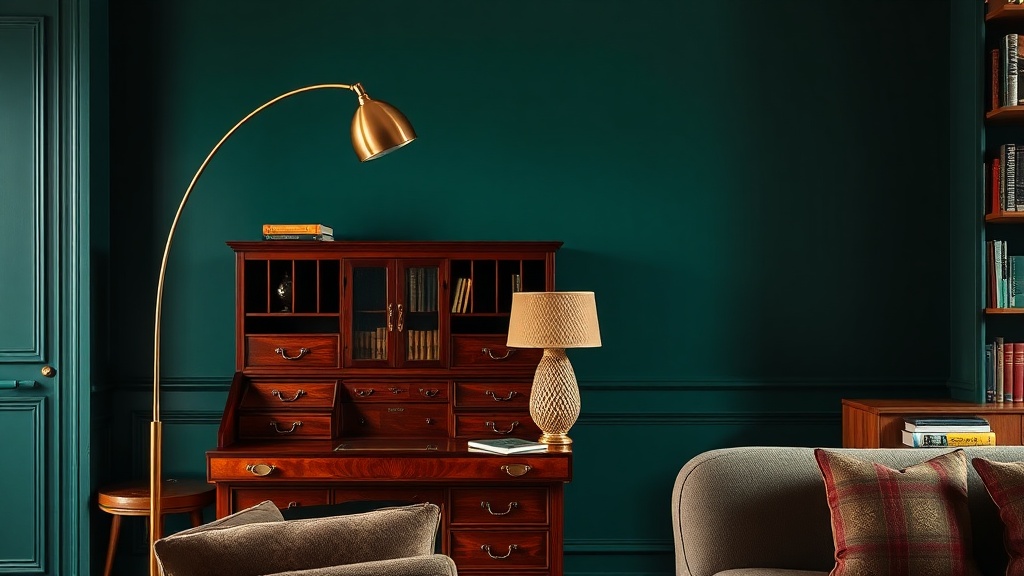
Here's a real example: I found a Georgian-style secretary desk at an estate sale in Evanston—gorgeous carved legs, solid mahogany, very 18th century—for $180. (The pricing was chaotic. The estate sale company clearly had no idea what they had.) I put it in a corner with a modern arc lamp ($65, Marketplace), three stacked vintage hardcovers ($12 total), and a ceramic lamp that's clearly 1970s California studio pottery ($40, estate sale in Oak Park).
Different eras, different origins. But: same warm wood tones, similar scale, all acquired objects with actual history. The tension is in the century gap. The coherence is in the material and warmth. That corner costs under $400 including the desk, and it holds its own visual weight against a much bigger, more expensive room.
That's the 70/30 in practice.
Where Abundance Actually Comes From (Without the Budget Explosion)
Let me give you the sourcing playbook, because this is where intentional maximalism beats minimalism economically and creatively.
Estate sales over thrift. I know, I know—thrift stores are the gateway. But estate sales are where the density is. You're clearing a household, not a donation pile, so you're looking at coordinated objects that already have a relationship with each other. A set of four botanical prints that lived in the same dining room for forty years? Already a coherent unit. A collection of brass candlesticks that sat on the same mantle? They already know each other. The spatial relationships were worked out decades ago. You're just relocating them.
Estate sales also have a timing mechanic most people don't exploit: day three pricing. The first day has full prices and the good stuff. Day three, whatever's left is often marked down significantly—30 to 75 percent off, depending on the company running the sale—and "whatever's left" is usually the large furniture, the weird multiples, and the decorative density pieces (read: maximalism inventory). Show up Sunday morning.
Marketplace seller psychology. When someone lists a single decorative item—one lamp, one vase—they price it based on what they think it's worth. When someone lists "moving, EVERYTHING MUST GO, 47 items priced in post," they're pricing it based on what they need the space for. Those are the sellers to find. Text first, ask if they have more that isn't listed. You'd be shocked how often the answer is "actually yes, come by and look."
Strategic tier mixing. This is the one that makes the most difference aesthetically. Your anchor pieces should carry the budget. One genuinely excellent large piece—a quality velvet sofa, a solid wood table, a real area rug—does more work than five cheap pieces trying to fake it. Then let your supporting and accent layers be sourced ruthlessly. My rule: never pay retail for anything that isn't your anchor. Everything else is the hunt.
I have a $35 ceramic bowl that is, genuinely, one of the most beautiful objects I own. Bought from a ceramicist who was selling off studio seconds at an open-studio event. It has a hairline crack that you can barely see and a glaze that's technically a mistake—a color that fired slightly wrong. It's also irreplaceable. Budget pieces with actual history will always beat expensive pieces with no story, in a maximalist room especially.
The Confidence Check: Are YOU Actually a Maximalist?
Here's the question I get most often, and I want to answer it honestly: How do I know if I want this or if I just saw it on Pinterest?
Ask yourself three things before you bring anything else into a maximalist room:
Where would it live? Not "where could it technically fit"—where would it live. Is there a surface, a corner, a wall section where it belongs? Maximalism isn't about absence of intention; it's about more intention applied to more objects. If you can't picture the specific location, you're buying it for the fantasy, not the room.
Does it add a layer or start a new one? Every piece should either reinforce an existing layer in your room (supporting) or create a deliberate tension point (accent). If it's a third layer that doesn't connect to anything—new color, new scale, new era, new texture, no bridges—it's not adding abundance, it's adding noise.
Would you keep it if it cost four times more? This is my actual test. Strip the price tag out of the decision. A piece you'd pay four times what it costs is a piece you actually want. A piece you want because it's cheap is a piece you'll be tired of in eighteen months.
Maximalism done well is selective about everything except quantity. You're allowed to want more—more color, more texture, more objects with history and weight and meaning. The design world will tell you that restraint is sophistication. I'm telling you that restraint is often just a different budget strategy dressed up as taste.
The room that tells your story completely isn't a mistake. It's the point.
Your abundance is valid. Design it intentionally.