Sofa Buying in 2026: The 10-Minute Spec Audit That Saves You From Fast Furniture

Sofa Buying in 2026: The 10-Minute Spec Audit That Saves You From Fast Furniture
A sofa is not a decorative pillow with ambition. It is a load-bearing decision you will sit on every day for years.
If a listing gives you twelve moody photos and one sentence of construction info, that is not premium. That is concealment. Today we fix that with a 10-minute audit you can run before you click "buy."
The 10-Minute Sofa Audit
1) Frame: Ask what the skeleton is made of
You want a solid hardwood or engineered hardwood frame with explicit construction details. If the brand only says "wood frame" and won't clarify species or method, treat it as a red flag.
What I ask for in writing:
- Frame material details (not just "wood")
- Joinery method (dowels, corner blocks, screws, and glue)
- Warranty length on the frame
If they cannot answer in plain language, you have your answer.
2) Joinery: Look for corner blocks and mechanical reinforcement
A durable frame usually combines glue plus mechanical fastening. I want to see words like corner-blocked, doweled, or mortise-and-tenon.
What I avoid: vague phrases like "expertly crafted" with no mention of how the frame is actually locked together.
3) Suspension: Don't get hypnotized by buzzwords
People obsess over "8-way hand-tied" as if it's automatically superior. It's not that simple. A well-built sinuous spring system can also perform well.
The real question is this: does the seat stay supportive after daily use? Ask for suspension details and warranty terms, not mythology.
4) Cushions: Learn two foam words and stop guessing
You need the fill composition. Not "plush." Not "cloud-like." Actual specs.
Minimum useful info:
- Foam density range
- Whether cushions are reversible
- Whether covers are removable for cleaning
If density is never disclosed, that usually means the brand doesn't want comparison shopping.
5) Fabrics: Decode abrasion ratings without becoming a textile scientist
For active households, ask for a double-rub number and cleaning code. You don't need perfection; you need transparency.
The practical part:
- Ask for care code (like W, S, WS)
- Ask whether the fabric is performance-treated or inherently durable
- Ask whether replacement covers are available
A gorgeous fabric you can't maintain is a future argument with your own life.
6) Labels: Use compliance tags as a truth source
Upholstered furniture sold in the U.S. must follow flammability and labeling rules. Composite-wood components can also carry formaldehyde compliance labels.
What to look for:
- Flammability/compliance statement on the law label
- Fiber/fill disclosure in law-label language
- TSCA Title VI labeling on relevant composite wood components when applicable
This does not prove a sofa is luxurious. It does prove the seller is speaking in verifiable terms.
7) Dimensions: run the tape test before checkout
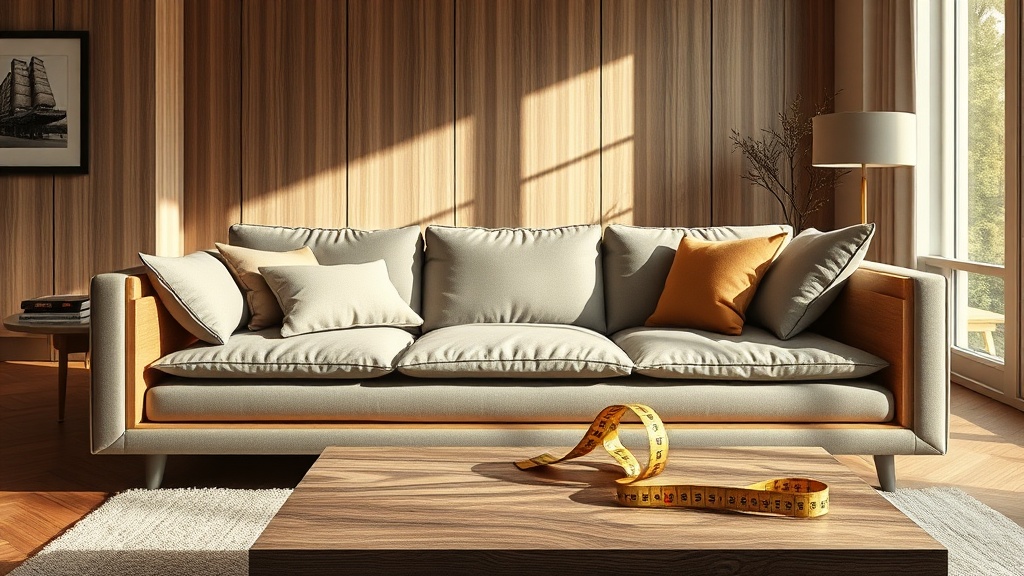
I carry a brass tape for a reason. Most returns happen because scale was never tested.
Check these four numbers against your room and body:
- Overall width
- Overall depth
- Seat height
- Seat depth
If you like to lounge sideways, a 21-inch seat depth can feel mean. If knees hate low seating, a very low seat height will punish you daily.
8) Delivery reality: white-glove is not white-glove by default
Ask exactly what "white-glove" includes.
- Does the team remove packaging?
- Do they place the sofa in-room?
- Are stair carries included?
- What's the return fee if fit fails?
A cheap sofa becomes expensive when logistics are sloppy.
9) Replacement ecosystem: Can you repair this piece?
Ask if you can order:
- Replacement cushion inserts
- Slipcovers or replacement covers
- Matching fabric by the yard
If everything is disposable, it is not a bargain. It's a delayed bill.
10) Warranty: read what is excluded
Many warranties look generous until you hit exclusions for normal wear, compression, pilling, transport damage windows, or misuse clauses.
My rule: if warranty language feels evasive, assume claim friction later.
The High-Low Strategy (Where to Spend, Where to Save)
If your budget is finite, spend on structure and save on styling layers.
Splurge on:
- Frame construction and suspension
- Fabric durability where daily contact happens
- Service quality and return terms
Save on:
- Trendy leg finishes
- Throw pillows
- Temporary styling accessories
You can change pillows in five minutes. You cannot retrofit a weak frame into integrity.
The "Designed to Die" Red Flags
Walk away if you see three or more of these:
- No frame details beyond "wood"
- No cushion density disclosure
- No clear care code
- No meaningful warranty language
- Vague delivery and return fees
- No replacement-parts pathway
Good brands do not fear specifics.
Source File (No Gatekeeping)
- U.S. CPSC upholstered furniture FAQ (federal flammability alignment with TB117-2013): https://www.cpsc.gov/FAQ/Upholstered-Furniture
- California Bureau of Household Goods and Services, TB117-2013 FAQ: https://bhgs.dca.ca.gov/forms_pubs/tb117-2013_faq_0619.pdf
- U.S. EPA formaldehyde emission standards (TSCA Title VI, composite wood products): https://www.epa.gov/formaldehyde/formaldehyde-emission-standards-composite-wood-products
Bottom Line
The right sofa is not the prettiest one on your feed. It's the one with a transparent spec sheet, repair path, and construction that respects your daily life.
Don't buy adjectives. Buy architecture.