The Layering Blueprint: How Maximalism Actually Works (Spatially, Mathematically, Intentionally)

The failure mode in maximalism isn't too much stuff. It's too much stuff with no internal logic.
I've walked through exactly this kind of room. Beautiful objects, genuinely good pieces—a kilim rug, a brass floor lamp, three different ceramic vases, a gallery wall that took weeks—and the whole thing reads as noise. Not because the person had bad taste. Because they were layering without a spatial framework. They were stacking without understanding weight.
That's a solvable problem. And it's not solved by buying less. It's solved by understanding how density functions in a room.
The Weight System (Your Architecture 101 Lecture)
Every object in a room has visual weight. This is not mystical. It's measurable. Dark colors read heavier than light ones. Large-scale patterns carry more weight than small ones. Matte finishes absorb attention; high-gloss bounces it back into the room. Organic shapes feel lighter than rectilinear ones. A room reading as chaos is almost always a room with mismanaged visual weight—too much heavy mass at eye level, no breathing space in the vertical plane, no clear hierarchy.
When I was still in studio—M.Arch, second year, visual composition critique—my professor called this "spatial density without spatial intent." You can have high density (maximalism) and spatial intent. Those aren't opposites. Le Corbusier's Five Points—published 1926—were about structural rationalization, not the elimination of ornament. The pilotis, the free plan, the horizontal window: these were arguments for freedom, not austerity. It's Mies van der Rohe who gave us "less is more," and even that phrase gets decontextualized—Mies said it about the discipline of steel-and-glass construction, not about whether your bookshelf can have thirty objects on it. What both of them were actually arguing against was arbitrary accumulation—ornament without logic. The principle: every element should earn its place.
That principle works for a Parisian apartment packed floor-to-ceiling with objects. It works for a Chicago two-flat with a collector's library and wall-to-wall rugs. What it doesn't work for is the "I bought everything I liked and now my living room feels like a storage unit" problem.
The fix is hierarchy, not subtraction.
The 70/30 Framework (The Actual Rule)
Here's the working system I use when I'm sourcing for clients who want maximalist rooms:
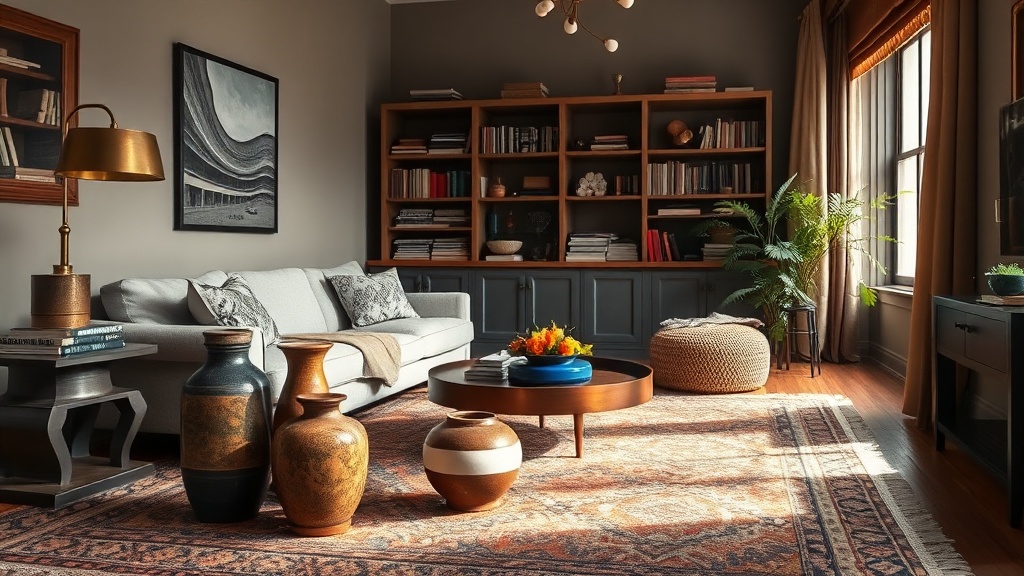
70% of your visual plane should be cohesive—color temperature, material family, scale register. This is your foundation. It doesn't mean everything matches. It means everything speaks the same language. A warm room: aged wood, amber glass, oxidized brass, terracotta, ivory linen. Those don't all "match." They all share a warm-neutral undertone. That's the 70.
30% is your intentional rupture—the piece that breaks the pattern and makes the whole room interesting. The one cool-toned blue ceramic in a warm room. The lacquered black side table in an organic, natural-material space. The graphic print in a room of quiet solids. Without the 30, you have a room that's harmonious but flat. Without the 70, you have a room that's visually shouting in twelve languages at once.
Maximalism lives entirely within this framework. It's not about whether you have fifteen things on a shelf or three. It's about whether those fifteen things share a coherent visual logic. I've seen rooms with two pieces of furniture and a gallery wall that felt maximalist in the best possible way—layered, considered, abundant. I've seen rooms with thirty "statement pieces" that felt like a flea market that hadn't been sorted yet.
The density is fine. The logic is the variable.
Reading a Room: The Three-Tier Hierarchy
When I start sourcing for a dense, layered room, I work in three tiers:
Anchor pieces (roughly 15–20% of the room's visual budget): These set the dominant material and scale. Sofa, rug, primary art, large textile. In a maximalist room, these can be bold—but they need to be resolved. A large-scale pattern rug works here. A sofa in a saturated jewel tone works here. What doesn't work: two equally dominant patterns at the same scale competing for the anchor position. That's where rooms break.
Supporting pieces (roughly 50–60%): Your furniture, secondary textiles, ambient lighting, bookcase objects, plant groupings. This is where you build the density. The kilim pillow stack, the layered throw, the row of mismatched ceramics. This tier can be wildly varied in object type as long as it stays within the 70% color-temperature logic. A brass table lamp, a rattan side table, a stack of art books, a trailing pothos, a woven basket—these read together because they share warmth and organic material resonance, not because they came from the same store.
Accent pieces (roughly 20–25%): Small objects, the 30% ruptures, the things that create moments. A single cobalt blue vessel in an amber room. A chrome picture frame in an otherwise matte space. The sculptural object that doesn't "belong" and is better for it. This tier is where maximalism gets its personality.
If you're building a room and it feels chaotic, do this diagnostic: look at your anchor tier first. Is there a clear dominant? Now look at your supporting tier—does it honor the material logic of the anchor? Then look at your accent tier—is there only one (or at most two) clear "ruptures," or are you rupturing in seven directions?
That's usually where the chaos lives. In the accents.
The Sourcing Playbook: Building Abundance Without a Budget Explosion
Let me give you real numbers because this is where the gatekeeping gets genuinely sinister. "Maximalism is for people who can afford it" is one of the more persistent lies in interior design media. It exists because the brands with ad budgets benefit from you believing it. A curated, restrained, expensive-material minimalist room is a higher-margin sell than a maximalist one you built yourself for a fraction of the cost.
What follows are my own sourcing numbers—Chicago-area Marketplace, early 2026. Your market will vary. Treat these as directional, not fixed. The principle holds regardless of the exact figures; the category logic is what matters:
Ceramic vase groupings (the three-vase cluster everyone wants): $15–$40 for the set. You're looking for estate sale lots from people who accumulated over decades. Search "ceramic vase lot" or "pottery collection." The $200+ version from a boutique is the same object with different distribution.
Stacked textile situation (the sofa with three layers of throw, four mismatched pillows): $25–$60 if you're patient. Vintage wool throws are everywhere. Surplus woven blankets, lumbar pillows from a seller who over-ordered. The key is that they share a warm undertone—you can mix tribal geometric with stripes with solid if they're all in the same color temperature register.
The statement rug (the hardest anchor to find, the highest-impact item): $50–$150 for a genuine vintage kilim or flat-weave in good condition. It takes time. You need to check condition carefully—corner fraying is cosmetic, backing deterioration is structural. Set a saved search, check Sunday nights, and be willing to drive.
Bookcase objects (the most over-purchased category in maximalism): Free to $5 per object at estate sales. Old books by color and spine width, not title. Ceramic objects from someone's grandmother's collection. Vintage glass inkwells. Small framed prints. The maximalist bookcase is built from accumulated living, not from an online cart.
In my experience, a fully layered supporting tier lands in the $150–$300 range if you're systematic and patient—not $1,500, not $3,000. That gap widens or narrows depending on your city and timing, but the order of magnitude holds.
The lie is that abundance requires expenditure. Abundance requires accumulation with a logic. Those are different things.
The Confidence Check: Is This What You Want, Or What the Algorithm Wants?
The hardest question in maximalism isn't spatial. It's psychological.
Before you add the fourth plant, the seventh throw pillow, the second gallery wall section—ask: does this object speak to the existing logic of this room, or am I reacting to something I saw online yesterday?
I call this the sourcing mindset applied inward. When I'm at an estate sale, the question isn't "is this beautiful?" The question is "is this right for this specific room, in this specific tier, in this specific logic?" You pass on beautiful things constantly. Not because they're wrong in general—because they're wrong here.
Your room has an existing DNA. Sometimes it's still being built, still becoming itself—that's fine. Maximalism is a long game. But every object you add is either deepening the coherence or introducing a new language the room now has to metabolize.
Maximalism that works is maximalism built over years, not weekends. The rooms that stop your breath—the ones that feel full and alive and intentional—were built by someone who kept asking: does this earn its place? Does it deepen what's already here?
That's the skill. Not the willingness to accumulate. The willingness to discriminate while accumulating.
The "more = mistake" rule isn't design theory. It's a class marker. It's a way of telling people with less money, less space, more accumulated objects that their spaces are aesthetically inferior—while selling them a $2,000 linen sofa as the corrective.
Intentional density is a skill. It has rules. You can learn them. And once you have them, you can build the rich, layered, abundant room you actually want—for a fraction of what the minimalism industry thinks your space should cost.
Your abundance is valid. Design it intentionally.