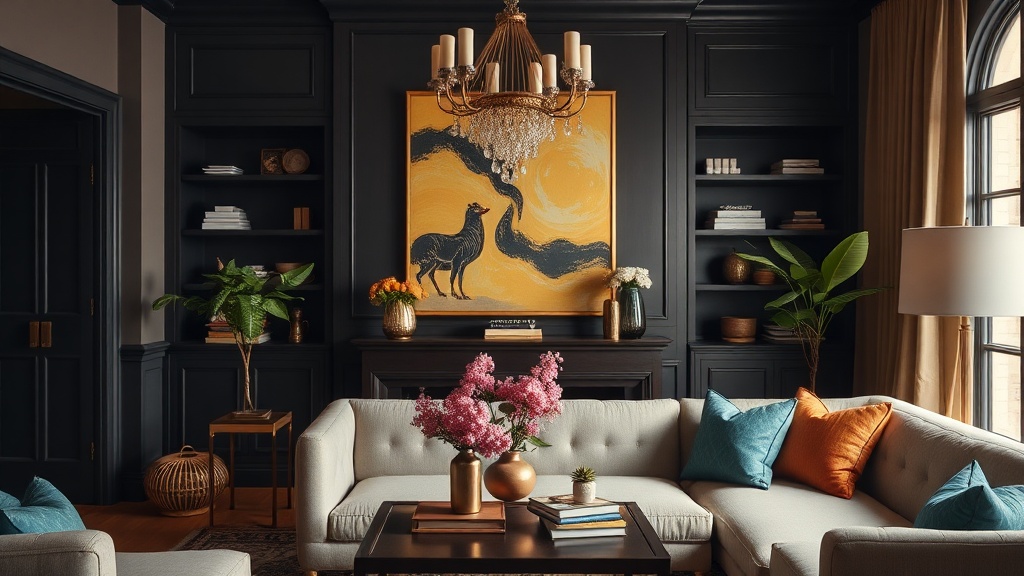
The Rule of Three: A Decorator's Secret Weapon for Perfect Styling

Quick Tip
Grouping objects in odd numbers, especially threes, creates visual interest and balance that feels more natural and engaging than even-numbered arrangements.
Why the Rule of Three Changes Everything
This post explains the Rule of Three—a fundamental styling principle that transforms flat, forgettable surfaces into dynamic, magazine-worthy vignettes. Understanding this technique eliminates the guesswork from shelf styling, coffee table arrangements, and mantel displays, delivering professional results without hiring a designer.
The Science Behind the Styling
The Rule of Three operates on a simple premise: objects grouped in odd numbers, particularly three, create visual tension and movement that even-numbered arrangements lack. When the eye encounters two matching items, it rests. Three items force the brain to process relationships, creating natural flow across a composition.
Neuroscience backs this up. A 2012 study from the University of Toronto found that odd-numbered groupings hold attention 40% longer than symmetrical pairs. The asymmetry creates what designers call a visual triangle—three points that guide the eye in a continuous loop rather than a static back-and-forth.
Real-World Applications
Concrete examples make this tangible. On a 48-inch console table, try a 24-inch ceramic table lamp from West Elm, a stack of three design books—Living with Nature by Nathalie Farman-Farma alongside two vintage tomes measuring 3 inches total—and a 6-inch brass object like the Jonathan Adler Futura Pyramid ($98). The heights vary at 24 inches, 3 inches, and 6 inches, creating a 4:1 ratio between tallest and shortest elements.
For a 36-inch diameter coffee table, start with a sculptural object around 10 inches tall—the Menu Échasse Hurricane vase ($195) works beautifully. Add a low element: a 2-inch travertine catchall from CB2 ($49). Complete the triangle with a mid-height stack of two books (3 inches) topped with a 2-inch geode. Total height range spans 2 to 10 inches, with the middle element bridging the gap.
Mantel styling follows similar math. On a 60-inch fireplace surround, place the tallest element at one end—a 30-inch fiddle leaf fig in a 12-inch planter (42 inches total). At the opposite end, position a 12-inch framed print. Between them, group three candlesticks of varying heights (12", 16", 20") as a single 20-inch unit. This creates asymmetrical balance that draws the eye across the entire surface.
Budget-Friendly Execution
The technique adapts to any budget. A $25 IKEA LACK shelf becomes gallery-worthy with three objects: a $14 FÄRGRIK vase (8 inches), a free gathered branch at 18 inches, and a thrifted brass bowl at 4 inches. Total cost: under $40.
Avoid the trap of matching sets. Three identical candlesticks read as one bulky object. Instead, vary material, texture, and height while maintaining a cohesive palette: ceramic + metal + organic material.
Putting It Into Practice
- Start with height: Identify your tallest element first—typically 1.5 to 2 times the height of your shortest piece.
- Add contrast: Mix hard and soft materials. Pair a glass vase with a woven sphere and a marble bookend.
- Step back: View from 6 feet away. If the eye stops at any single object, the balance needs adjustment.
The Rule of Three provides a framework, not rigid dogma. Begin with three elements, assess the visual weight, then trust the eye to guide final adjustments. Professional styling isn't about expensive pieces—it's about intentional relationships between objects.