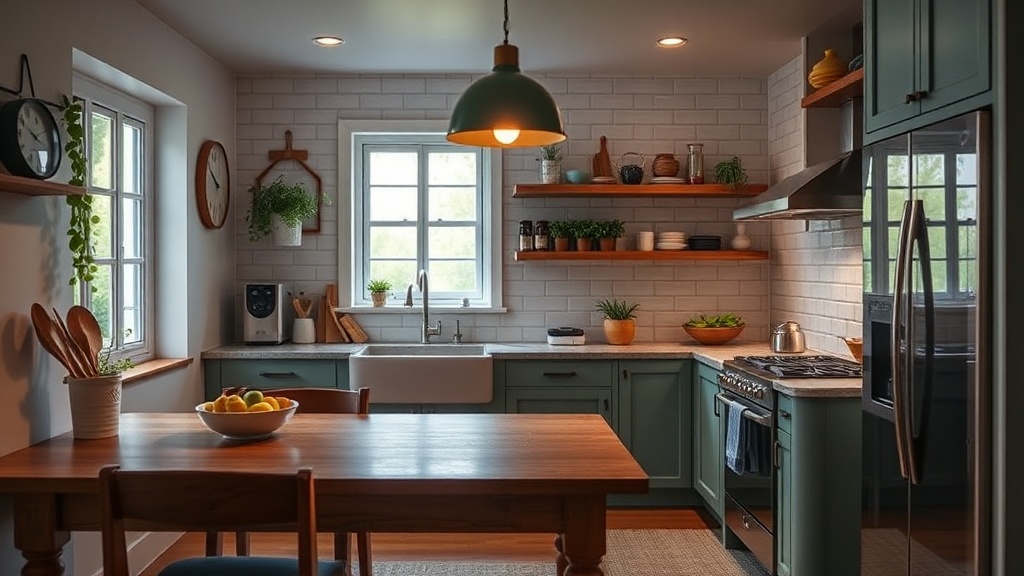
Ways to Make a Small Kitchen Feel Much Larger

The biggest mistake people make when dealing with a cramped kitchen is thinking they need more square footage. You don't need an addition; you need better visual management. Most homeowners believe that adding more heavy, dark cabinetry or cluttered countertop appliances is the only way to make a kitchen "functional," but this actually shrinks the perceived volume of the room. This guide breaks down the architectural principles of light, line, and scale to help you manipulate your kitchen's dimensions through strategic design choices rather than expensive structural changes.
The Illusion of Depth Through Color and Light
Color is not just an aesthetic choice; it is a mathematical tool used to manipulate how the eye perceives boundaries. In a small kitchen, the goal is to minimize the visual "stops" that tell your brain where a wall begins. When a wall is a high-contrast color against a white ceiling, the eye hits that line and stops, making the ceiling feel lower and the walls feel closer.
Utilize Monochromatic Palettes
To expand a space, use a monochromatic or low-contrast color scheme. If your walls are a soft off-white, consider painting your upper cabinets in a similar shade. This creates a continuous plane that allows the eye to glide over the cabinetry rather than jumping from one object to another. For a more sophisticated look, use varying textures of the same color. A matte white wall paired with a high-gloss white subway tile backsplash creates depth without the visual clutter of a new color.
Maximize Natural and Layered Light
Dark corners act as visual anchors that pull the walls inward. To combat this, you must address both natural and artificial light. If you have a window, avoid heavy drapery. Instead, use a simple roller shade or a light-filtering linen. For artificial light, move away from a single, heavy central pendant that hangs low and obstructs the sightline. Instead, utilize under-cabinet LED strip lighting. This illuminates the task area and makes the backsplash feel like a deep, lit-up alcove rather than a flat wall. Adding a small, directional spotlight or a slim track lighting system can also push the light toward the perimeter, effectively "pushing" the walls out.
Visual Weight and the Importance of Negative Space
In architecture, "visual weight" refers to how much an object appears to weigh on the eye. A heavy, dark oak breakfast nook will feel much more imposing in a 10x10 kitchen than a slim, metal-legged bistro set. To make a kitchen feel larger, you must reduce the visual weight of your furniture and fixtures.
Choose Legs Over Bases
Furniture that sits directly on the floor, such as a heavy pedestal table or a solid base kitchen island, creates a visual block. Instead, opt for furniture with slim, tapered legs. When you can see the floor extending underneath a chair or a kitchen island, the brain perceives more continuous floor area, which translates to a larger room. A mid-century modern style chair with thin metal legs is an excellent way to add seating without sacrificing perceived space.
The Magic of Open Shelving
Upper cabinets are often the biggest culprits of "clutter fatigue." They are heavy, opaque boxes that hang over your head, creating a sense of enclosure. Replacing one or two upper cabinets with reclaimed wood floating shelves or minimalist metal shelving can instantly open up the room. By exposing the wall behind the shelves, you create a sense of depth. However, use this technique with discipline. If you use open shelving, your dishware must be organized and aesthetically cohesive. A mismatched collection of colorful mugs will create visual noise, which has the opposite effect of making a space feel large.
Reflective Surfaces and Sightlines
One of the most effective ways to "cheat" a room's dimensions is by using reflection. A mirror or a highly reflective surface doesn't just bounce light; it creates a "window" into a non-existent space.
Strategic Mirror Placement
While mirrors are common in dining rooms, they are an underrated tool in small kitchens. Placing a large, thin-framed mirror on a wall opposite a window will reflect the outdoor view and the natural light, effectively doubling the perceived depth of the room. If a full mirror feels too much for a kitchen setting, consider a backsplash made of polished stone or high-gloss ceramic tiles. A polished marble backsplash, for example, provides a subtle reflection that adds a sense of luxury and light without the literalness of a mirror.
Glass Cabinetry and Transparency
If you aren't ready to commit to full open shelving, use glass-front cabinet doors. This is particularly effective for upper cabinets. The transparency allows the eye to see "through" the cabinet to the back wall, breaking the solid barrier of the wood or laminate. This technique works best when the interior of the cabinet is well-lit or features a neutral-colored backdrop. For a more contemporary look, use fluted or frosted glass, which provides the sense of depth and light without showing every piece of clutter inside.
Streamlining the Countertop and Perimeter
A cluttered countertop is the fastest way to make a kitchen feel claustrophobic. When every inch of a surface is covered, the "work zone" feels non-existent, and the room feels smaller than its actual footprint.
The "One-In, One-Out" Rule for Appliances
Small kitchens cannot accommodate a stand mixer, a toaster, a coffee maker, and a blender all sitting on the counter simultaneously. To maintain a sense of scale, designate a "hidden station" for appliances. This might mean a dedicated appliance garage—a small cabinet with a pull-down door—or simply tucking them into a corner. If you must have them out, choose a cohesive color palette. A set of matte black appliances will look much more intentional and less cluttered than a mix of chrome, white, and stainless steel.
Vertical Storage Solutions
Instead of taking up valuable counter space, move your storage upward. Use magnetic knife strips on the backsplash to free up the block of space usually occupied by knives. Use a hanging rail system, like the IKEA Hultarp series, to hang utensils, small colanders, or even herb pots. This utilizes the vertical plane, which is often underused in small kitchens, and keeps the horizontal surfaces clear, maintaining the illusion of more workspace.
Scale and Proportion: The Final Layer
The final step in designing a larger-feeling kitchen is ensuring your decor is proportional to the space. A common mistake is using many small, "precious" decorative items. A collection of ten small spice jars and three tiny succulent pots creates a "stutter" in the visual flow. It is much more effective to have one medium-sized, high-quality item—like a single large ceramic vase or a single large wooden cutting board—than a dozen small trinkets.
By focusing on these architectural principles—light, line, and weight—you can transform a cramped kitchen into a high-functioning, airy space. Design is not about how much you can fit into a room; it is about how much you can make the eye perceive. Focus on the continuous lines, the reflective surfaces, and the reduction of visual weight, and your kitchen will feel significantly larger without moving a single wall.