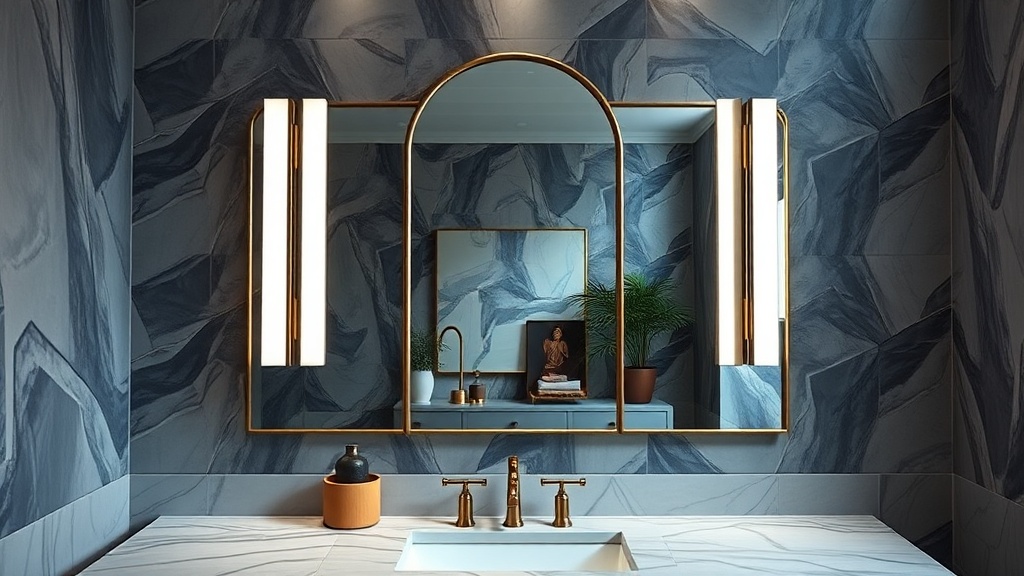
Why Does Your Mirror Feel Like an Afterthought Instead of a Design Statement?

Have you ever hung a mirror and stepped back only to feel... underwhelmed? You're not alone. Most people treat mirrors as purely functional objects—something to check your hair in before leaving the house. But a mirror is actually one of the most powerful tools in your design arsenal. It can double your natural light, fake an extra window, or anchor an entire wall. When placed with intention, a mirror becomes architecture. When it's an afterthought? It reads like a sad hotel bathroom fixture that wandered into the wrong room.
The good news: fixing this doesn't require a bigger mirror budget. It requires thinking like someone who understands that placement, proportion, and purpose matter more than the frame's price tag. Here's how to stop treating mirrors like wall decorations and start using them like the spatial magicians they are.
What's the Rule for Mirror Height, and Why Does Everyone Get It Wrong?
Here's the mistake I see in nine out of ten homes: mirrors hung too high. The center of your mirror should hit around 57 to 60 inches from the floor—that's gallery height, and it works because it aligns with average eye level. When you hang a mirror above a console or dresser, the gap between furniture top and mirror bottom should be roughly 4 to 8 inches. Any higher and the mirror starts to float awkwardly, disconnected from everything beneath it.
In bathrooms, this rule bends slightly. A vanity mirror's bottom edge should sit about 5 to 10 inches above the sink surface. Go lower if you're tall, higher if you're shorter—but never so high that you're doing calf raises to see your face. The mirror should serve you, not the other way around.
For full-length mirrors, angle matters as much as height. Leaning a floor mirror at roughly 15 degrees against the wall does two things: it reflects more of the room (creating that coveted depth illusion), and it prevents the funhouse-mirror effect that happens when you stand too close to a vertical surface. If you're mounting a full-length mirror on a door or wall, position it so you can see your shoes and the crown of your head with about a foot of clearance on either side.
Can a Mirror Actually Make Your Room Feel Bigger, or Is That a Design Myth?
It's not a myth—but the execution trips people up. Mirrors don't automatically expand space. They expand light, which creates the feeling of space. Hang a mirror opposite a window and you've essentially doubled your daylight. Hang it opposite a blank wall and you've doubled... a blank wall. Not exactly transformative.
The sweet spot is positioning mirrors to capture and redistribute what you already have. In a narrow hallway? A mirror at the end creates visual depth that stops the tunnel effect. In a dark corner? A mirror angled to catch light from a nearby window bounces brightness exactly where you need it. Architectural Digest's guide to using mirrors breaks down specific placement strategies for challenging spaces.
Scale matters here too. One oversized mirror makes a statement and opens a room. Three small mirrors clustered together? That's a gallery wall—charming, but not expansive. If your goal is spatial transformation, commit to size. A mirror should be at least two-thirds the width of the furniture beneath it, or it looks like a postage stamp on an envelope.
How Do You Style Around a Mirror Without It Looking Cluttered?
This is where the former architect in me gets particular. A mirror creates a focal point whether you plan for it or not. Everything within its reflection becomes part of your composition—so treat that reflected view as carefully as the wall itself.
If you're hanging a mirror above a console table, resist the urge to flank it with matching lamps and a perfectly centered vase. That symmetrical formula reads staged, not lived-in. Instead, try this: one substantial piece (a lamp, a sculpture, a stack of books) on one side, and something organic—branches in a vessel, a trailing plant—on the other. The mirror captures this asymmetry and doubles the visual interest.
For mantels, the mirror-above-fireplace placement is classic for a reason. It draws the eye up, balances the hearth's weight, and reflects the room back at itself. But don't let it sit there naked. Layer in front: candles that create flickering light play, a small frame that breaks the rectangle, maybe a sculptural object with interesting silhouette. House Beautiful's mirror styling ideas include specific product recommendations and arrangement formulas that actually work.
One hard rule: never place a mirror where it reflects something you don't want to see twice. That means no mirrors facing laundry piles, cluttered desks, or—worst of all—television screens. You'll spend dinner staring at a reflected episode of whatever someone's watching in the other room. Not exactly ambiance.
What Mirror Shapes Work Where, and Which Ones Should You Skip?
Rectangles are safe. They're the vanilla of mirror shapes—reliable, predictable, and sometimes exactly what you need. But they're not your only option. Round mirrors soften spaces dominated by hard angles. They work beautifully above pedestal sinks, in entryways with boxy architecture, or anywhere you want to break up the grid of doors and windows.
Arched mirrors carry formal weight. They reference classical architecture—doorways, church windows, old buildings with actual craft. Use them in rooms that need gravitas: above a fireplace, in a formal dining room, or anchoring a headboard wall. The curve draws the eye upward and adds personality that rectangles simply can't deliver.
Asymmetrical and organic shapes (think blob mirrors, irregular edges, frames made from natural materials) have their place too—but sparingly. One sculptural mirror is art. Three competing organic shapes create visual chaos. Pick your moments. A statement mirror in an otherwise simple room works. A statement mirror competing with patterned wallpaper, bold furniture, and layered textiles? That's where things get muddy.
Skip mirrors with heavy ornate frames unless your room can handle the formality. That gilded Baroque piece might look stunning in a Parisian apartment, but in your suburban split-level it reads like costume jewelry with jeans. If you love the antique look, seek out pieces with patina and wear—something that feels discovered rather than purchased from a "French Country" catalog.
How Do You Mix Metals and Finishes Without Creating a Mess?
Your mirror frame doesn't need to match your faucet. It doesn't need to match your light fixtures, your hardware, or your door hinges. This obsession with metal coordination is relatively new and mostly unnecessary. What matters is intentionality, not matching.
If you have brass lighting and chrome faucets, a black-framed mirror bridges those tones beautifully. It creates a visual through-line without forcing everything into the same metallic family. Brass and black together? Sophisticated. Chrome and natural wood? Calming and organic. Mixed metals tell the story of a room collected over time rather than bought in a single afternoon.
Frameless mirrors solve this dilemma entirely. They disappear into the wall, letting the reflection do the work. In small bathrooms or busy spaces, going frameless removes one more visual layer and keeps things feeling clean. Apartment Therapy's mirror decorating guide offers practical advice on choosing between framed and frameless options for different room types.
The finish of the mirror itself matters too. Antique or smoked glass softens reflections and hides the harshness of overhead lighting. Clear mirror glass is crisp and modern but can feel clinical in the wrong space. Consider what you're reflecting—and how crisp you want that reflection to be.
Where Should You Absolutely Never Hang a Mirror?
Bedroom ceilings. (Yes, I've seen it. No, I won't explain why it's a bad idea.) Beyond that obvious choice, avoid placing mirrors where they create harsh glare or reflect direct sunlight onto furniture that will fade. That antique chair by the window doesn't need a mirror accelerating its sun damage.
Also reconsider mirrors in dining rooms if your dinner parties involve complicated emotional dynamics. Watching yourself eat—or watching your guests watch themselves—creates self-consciousness that kills conversation. Some spaces benefit from the honesty of reflection. Others need the softness of walls that don't talk back.
And please, stop hanging mirrors by the front door at face height unless you enjoy greeting guests who are checking their teeth. Entryway mirrors work best slightly higher or off to the side, where they expand the space without creating a grooming station in your vestibule. Your foyer isn't a powder room. Treat it accordingly.
A mirror is never just a mirror. It's light, space, architecture, and psychology bundled into a reflective rectangle (or circle, or arch, or asymmetrical blob). Place it with the same care you'd use to position a window—and watch your room transform without moving a single piece of furniture.