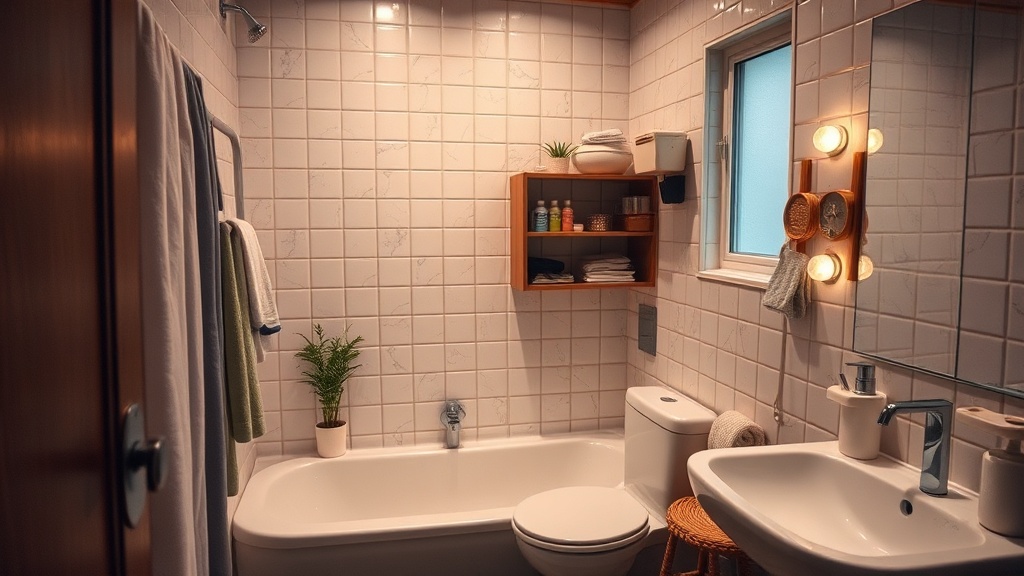
Why Does Your Small Bathroom Feel Cluttered and Cramped?

The Geometry of Tight Spaces
Why does a perfectly functional bathroom often feel like a chaotic storage locker? It isn't always about a lack of square footage; it's about how your eyes process the volume of the room. When you're working with a footprint smaller than a standard master bath, every single object carries more visual weight. If you place a bulky soap dispenser next to a cluttered toothbrush holder, you've just created a visual obstacle course. We need to look at the room through the lens of architectural volume rather than just "stuff." This means understanding that your eye needs places to rest—empty spaces that provide relief from the density of a small room.
The problem usually stems from a lack of intentionality in scale. People often buy "small space" accessories that are actually quite busy. A tiny, intricately patterned soap dish might look cute on a larger counter, but in a small bathroom, that pattern becomes a distraction. Instead, look for items with clean lines and low visual noise. Think about the relationship between the floor and the walls. If your vanity is a heavy, dark wooden block sitting directly on the floor, it effectively "eats" the floor space, making the room feel smaller. Swapping that for a floating vanity or even a wall-mounted sink can expose more floor, tricking the brain into seeing more room than actually exists.
How Do I Create More Storage Without Adding Bulk?
Most people reach for a plastic bin or a bulky shelving unit when they run out of room, but that's a mistake. Adding more physical objects actually increases the visual friction in the space. Instead of building outward, look upward. Verticality is your best friend in a compact bathroom. Use the wall space above the toilet or the door—areas that are usually dead space—to house functional items. A recessed medicine cabinet is a classic architectural solution for a reason: it hides the mess behind a flat plane that sits flush with the wall.
Consider the weight of your materials. If you're looking to add shelving, a glass or acrylic shelf is far less intrusive than a thick wooden one. It provides a surface for your items while remaining almost invisible to the eye. This is a trick we used constantly in studio apartments—minimizing the "edges" of objects helps the room feel more expansive. If you must have shelving, try to match the color of the shelf to the color of the wall. This reduces the contrast and keeps the focus on the function rather than the storage itself. You can find great examples of minimalist storage solutions through architectural resource sites like Architectural Digest, which often showcases how high-end designers handle tight footprints.
The Role of Light and Reflection
If you can't change the layout, change how light interacts with the surfaces. A single, harsh overhead light can make a small room feel like a utility closet. Instead, aim for multiple light sources at different heights. A small sconce near the mirror provides soft, indirect light that softens the edges of the room. Mirrors are the oldest trick in the book, but they work because they create an illusion of depth. However, don't just hang any mirror. A large, frameless mirror that extends almost to the ceiling can make the walls feel further away. It breaks up the hard stop of the wall and creates a sense of infinite space.
Can I Use Color to Make a Small Bathroom Feel Bigger?
There is a common myth that you should only use white to make a space feel larger. While white is great for reflecting light, it can also feel sterile and cold. You can use color to manipulate the perceived size of a room, but you have to be strategic about it. Darker colors can actually make a wall "recede." If you paint the back wall of a narrow bathroom a deeper, more saturated shade, it creates an illusion of depth. This is a concept known as receding color. On the other hand, if you want the room to feel wider, use horizontal lines or a bright, light-colored rug to draw the eye across the floor.
The goal is to avoid the "boxed-in" feeling. This is often caused by too much high-contrast detail. If your floor is a busy pattern, keep your walls and vanity solid. If your walls have a textured wallpaper, keep the countertop clear and simple. A cluttered visual field is the quickest way to make a person feel claustrophobic. Use the rule of three: group your daily items in sets of three, or better yet, keep only one or two items out on the counter. Everything else should be tucked away. For more technical guidance on material selection and spatial planning, the Dwell archives offer excellent insight into modern, small-scale living.
| Problem | The Common Mistake | The Architectural Fix |
|---|---|---|
| Limited Counter Space | Buying more small, cluttered items | Use vertical or wall-mounted organizers |
| Cramped Feeling | Using heavy, dark furniture | Opt for floating or wall-hung fixtures |
| Dark/Small Vibe | Single harsh overhead light | Layered lighting and large-scale mirrors |
| Visual Chaos | Too many competing patterns | Keep a consistent color palette and texture |
Ultimately, a small bathroom isn't a problem to be solved with more stuff; it's a volume to be managed. By prioritizing line, light, and verticality, you turn a cramped utility room into a functional, intentional part of your home. Stop looking at what you can add, and start looking at what you can clear away. The most expensive-looking bathrooms aren't the ones with the most stuff—they are the ones with the most breathing room.