Why Your Living Room Feels Unfinished and How to Fix It

You'll learn how to identify the missing pieces in your living room layout and how to use scale, proportion, and architectural weight to finish a space.
A room often feels "off" not because your furniture is bad, but because the visual weight is uneven. You might have a beautiful sofa and a high-end rug, yet the room still feels hollow or, conversely, cluttered and chaotic. This happens when the proportions between your objects don't talk to one another. We're looking at the structural logic of a room—the way pieces occupy space—rather than just picking out pretty things from a catalog.
Most people approach decorating as an additive process—adding more, adding more, until the room feels full. But interior design is actually a subtractive and balancing act. If your sofa is a heavy, low-slung velvet piece, and your coffee table is a spindly, thin-legged metal tripod, the sofa is going to visually swallow the table. The table will look like a toothpick in a sea of fabric. This lack of balance is the primary reason a room feels "unfinished" even when it's full of stuff.
Is my rug too small for my seating area?
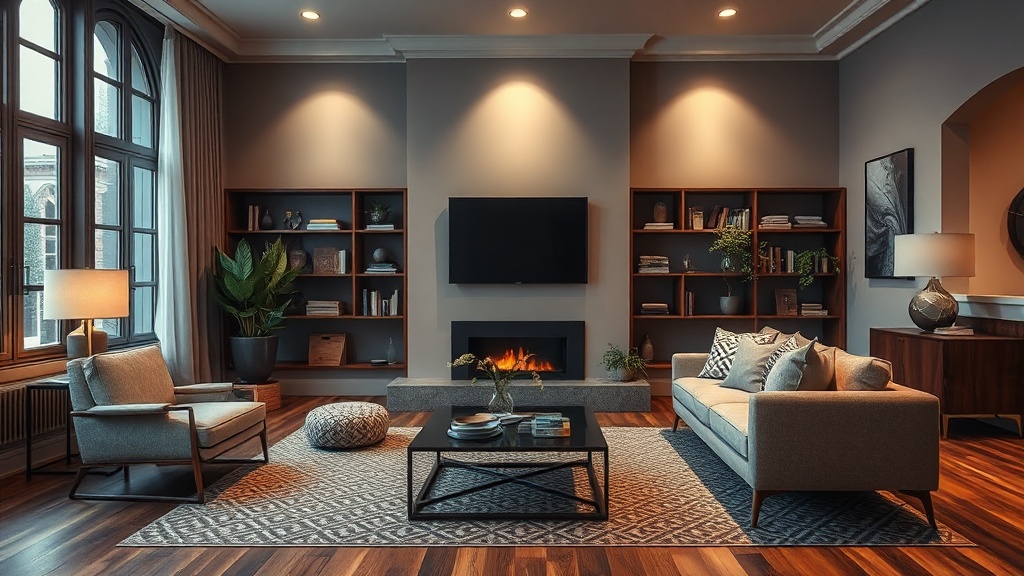
This is perhaps the most common mistake in residential design. A tiny rug acts as a visual island, making your furniture look like it's floating in a void. To avoid this, your furniture needs to have a physical relationship with the floor covering. At a minimum, the front legs of your sofa and any accent chairs should sit on the rug. If you're working with a smaller space, even just the front legs are enough to anchor the grouping.
Think of the rug as the foundation of a building. If the foundation is too small, the structure feels unstable. A larger rug creates a sense of cohesion, pulling disparate pieces into a singular, intentional zone. If you can't afford a massive wool rug, don't settle for a tiny accent rug that does nothing for the layout. Instead, look for high-quality jute or sisal options—they offer substantial texture and scale without the heavy price tag of silk or high-pile wool. You can find great dimensional rug inspiration through architectural resources like Architectural Digest to see how scale works in high-end settings.
The Rule of Proportions
When choosing a coffee table, don't just look at the length. Look at the height relative to your seating. If your sofa is deep and low, a high, spindly coffee table will look awkward and out of place. You want a piece that feels substantial enough to hold its own against the sofa. If you have a massive L-shaped sectional, a small circular table will look lost. You need a center point that commands the space without blocking the flow of movement.
Why does my furniture feel disconnected from the walls?
The instinct to push every piece of furniture against a wall is strong, especially in smaller homes. This is a mistake. Pushing everything to the perimeter creates a "waiting room" vibe—a hollow center where nothing happens. It also strips the room of its architectural depth. Instead, try to pull your seating even just a few inches away from the wall. This creates a sense of breathing room and makes the layout feel more intentional.
By pulling furniture toward the center, you create pathways and zones. This is where the concept of the "circulation path" comes in. A well-designed room accounts for how humans move through it. If you have to zig-zag around a coffee table to get to the kitchen, the layout has failed. Use your furniture to define these paths. If you have an open floor plan, use the back of a sofa to create a physical boundary between the living area and the dining area. This isn't just a design trick; it's a way to organize the geometry of your home.
How do I balance heavy furniture with lighter pieces?
Visual weight is a real concept. A dark, solid wood sideboard has much more visual weight than a glass-topped side table. If you put all your heavy pieces on one side of the room, the room will feel like it's tilting. To fix this, you need to distribute the weight. If you have a heavy sofa on the left, balance it with a heavy bookshelf or a large piece of art on the right.
You can also use color to manage weight. Darker colors feel heavier, while lighter colors feel lighter. If you have a massive, dark-colored sectional, try pairing it with lighter-colored accent chairs or a lighter-toned rug to prevent the room from feeling like a cave. This is a fundamental principle used by architects to ensure structures don't look lopsided. For more on the technical side of spatial arrangement, the American Institute of Architects resources often discuss the importance of scale and proportion in built environments.
Don't forget the vertical dimension. If all your furniture is low to the ground, the room will feel bottom-heavy. Bring the eye upward with floor lamps, tall plants, or drapery that hangs from the ceiling rather than just above the window frame. This draws the gaze up and makes the ceiling feel higher, which balances the weight of the furniture below.
Lastly, consider the "negative space." The empty space between your objects is just as important as the objects themselves. If every corner is packed with a lamp, a plant, and a basket, the room becomes visually loud and exhausting. Give your eyes a place to rest. A well-designed room uses empty space to highlight the pieces that actually matter. If you're feeling stuck, take a photo of your room, turn it to black and white, and look at the shapes. The shapes will tell you exactly where the balance is broken.