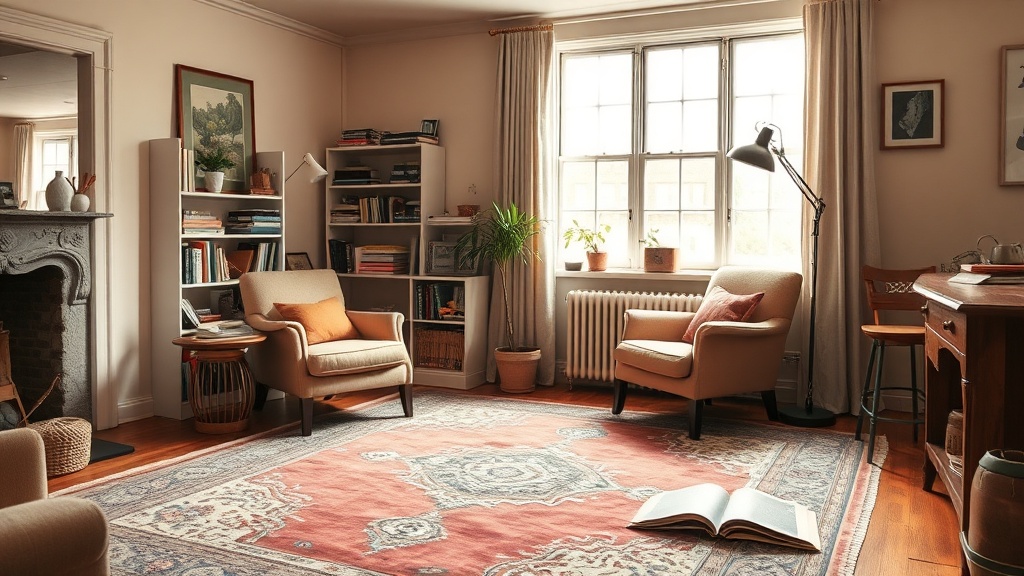
Your Space Doesn't Need Permission: Reclaiming Design Authority on IWD

I once sourced a hand-knotted Persian rug for a woman in Winnetka. Took me three weeks to find it—the right pile height, the exact dusty rose that her grandmother used to have on the back porch, the vintage weft irregularities that meant it was genuinely 80 years old and not a convincing fake from a showroom in downtown Chicago.
When I delivered it, she loved it. You could see it on her face—that specific relief of finally, the thing I meant. Then her husband walked in, glanced at it, and said, "Huh. Interesting choice." That was all. Just that. And she spent the next fifteen minutes explaining it to him. Justifying it. Walking him through the provenance, the color story, the way it would anchor the room.
She knew exactly why she wanted it. She didn't need to explain it. But she did anyway.
I watched that happen more times than I can count during my five years sourcing for private clients. Brilliant women—some of them running companies, managing six-figure renovation budgets, with sharper aesthetic instincts than any designer I've worked alongside—would find the thing they actually wanted, then immediately begin constructing the argument for why it was acceptable.
That's what I've come to call the approval trap. And in my experience, it doesn't live in Winnetka. It lives everywhere.
The Approval Trap (And Its Audit)
Here's what I mean when I say "designing for approval": you're making choices based on how they'll be received, not how they'll function for your actual life.
The approval trap has a very particular set of flavors. There's the partner approval version (choosing the "neutral" sofa that will photograph well at Christmas and offend no one). There's the family approval version (keeping the formal dining room you use four times a year because dismantling it feels like a statement about what kind of person you are). There's the hypothetical guest version—my personal nemesis—where entire rooms are designed around a dinner party that happens twice a year, while the person who actually lives there exists in functional discomfort the other 363 days.
And then there's the most insidious version, in my view: aspirational approval. The room staged for a version of yourself that doesn't exist yet—the self who has it together, who reads physical books in a curated reading nook, who would never leave a phone charger visible on the bedside table.
Quick audit. Go stand in the room that feels the most "off" to you right now. Ask yourself honestly: Is this room serving me, or is it performing?
If it's performing, for whom?
Design as Boundary-Setting
Here's something I took from architecture school that doesn't make it into most design conversations: space is not passive. Space does things to you. It communicates hierarchy, permission, movement, comfort, ownership. That's not woo—it's the theoretical foundation that Le Corbusier was reaching for when he called the house "a machine for living in." Not looking at. Not showing people. Living in.
When you make intentional design choices that serve your actual routine, that is—in my read of it—a form of boundary-setting. It is the concrete, literal act of saying: this space is organized around my needs.
Some specific places I see this play out:
Paint color. In my experience, "safe" colors—the endless parade of agreeable greiges and inoffensive whites—get chosen primarily because they offend no one, which means they serve no one in particular. If you've been living in a color that you've never loved because it came with the apartment or felt "timeless," you may be inhabiting a space optimized for resale value. Not for you. Warm, intentional colors can shift an entire room toward livability.
Furniture layout. The conventional furniture arrangement—chairs facing chairs, sofas angled toward each other—is designed around conversation and entertaining. Which is lovely if your primary activity in that room is conversation. But if you read, or paint, or do physical therapy exercises, or simply need one corner where you can see both the door and the window? Convention has nothing to offer you. Move the chair. Scale and placement matter more than tradition does.
Lighting. This is my strongest opinion in this piece: "atmospheric" lighting is a restaurant design convention, and it is—in my view—actively hostile to many of the things people actually do at home. If you've ever tried to read fine print, apply makeup, review documents, or do anything requiring visual precision under ambient mood lighting, you know exactly what I mean. "It's cozy" is often a euphemism for "I cannot see anything." Good task lighting isn't a luxury. It's the baseline. Layered lighting systems solve this problem by giving every activity the light it needs.
Storage. This is the room feature I find most psychologically loaded. "Aspirational" storage hides things away cleanly, pretending a life that doesn't require constant access to practical objects. Honest storage is organized around what you actually use and how often. Your daily vitamins don't belong in a cabinet behind closed doors if you forget to take them every time they're hidden. Your cleaning supplies don't belong in a beautiful lidded basket if you resent getting them out. The gap between your storage design and your actual habits is, in my experience, a reliable measurement of how much your space is working against you. Intentional maximalism—displaying what you actually use—beats hidden, resentful storage every time.
The Sourcing Mindset (Or: Ask What Before What Does It Look Like)
When I started sourcing for clients, I had one question I'd ask before anything else: What does this space need to DO for you?
Not "what aesthetic are you going for." Not "what's your Pinterest board saying." Not even "what's your budget" (though we got there). What does this space need to do.
The answers were almost always revelatory—and completely disconnected from the initial brief. The client who said she needed a "calming bedroom" actually needed blackout capability because she worked night shifts. The client who wanted a "functional home office" actually needed visual separation from the rest of her apartment because she couldn't psychologically clock out when she could see her desk from the couch.
Once you're clear on what the space needs to do, sourcing becomes a different game entirely. You're not chasing an aesthetic. You're solving a problem. And problem-solving doesn't require anyone's approval—it just requires accuracy.
Try it. Stand in any room. Ask: what does this space need to do for me, specifically, in my actual daily life? Not the aspirational version. Not the version that photographs well. The Tuesday-morning-running-late version. The sick-day version. The version that happens when nobody's watching.
That answer will tell you everything about what to change first.
Three No-Permission Actions for Right Now
March 8th is International Women's Day. I don't want to give you a mood board. I want to give you three concrete things you can do right now that shift your space toward your actual life.
1. Paint one wall the color you actually want.
Not the safe version. Not the color that "works with everything." The one you keep almost choosing and then talking yourself out of. One wall. One quart of paint. You can do it in an afternoon, and if it turns out you hate it, you can repaint it in a week. The cost of being wrong is negligible. The cost of spending another year in a room that doesn't feel like yours is not. (And yes, this includes ceilings.)
2. Move one piece of furniture to serve your routine, not convention.
Pick the piece that's positioned for tradition—the sofa facing the TV at a "proper" distance, the desk facing the wall because that's where the outlet is, the chair in the corner because chairs go in corners. Move it to where it would actually be useful to you. Give it two weeks. See what changes.
3. Remove one thing that doesn't serve you, even if it's "supposed to" be there.
This is the hardest one, because removal feels like a statement. The formal dining chairs you've always found uncomfortable. The decorative objects on the coffee table that you move every time you want to use the surface. The bed frame that's correct for the room size and wrong for your sleep habits. Pick one. Remove it. Put it in a closet. You don't have to get rid of it. Just see how the room feels without it.
Permission is internal. It's not granted by resale value, or the hypothetical guests, or anyone who might glance at it and say "huh, interesting choice."
Your space gets to work for you. That's the whole point.
Sloane Halloway is a Chicago-based design strategist and former sourcing consultant. She holds an M.Arch from the Illinois Institute of Technology and writes at DesignerDepot about closing the gap between the space you have and the space your actual life requires.