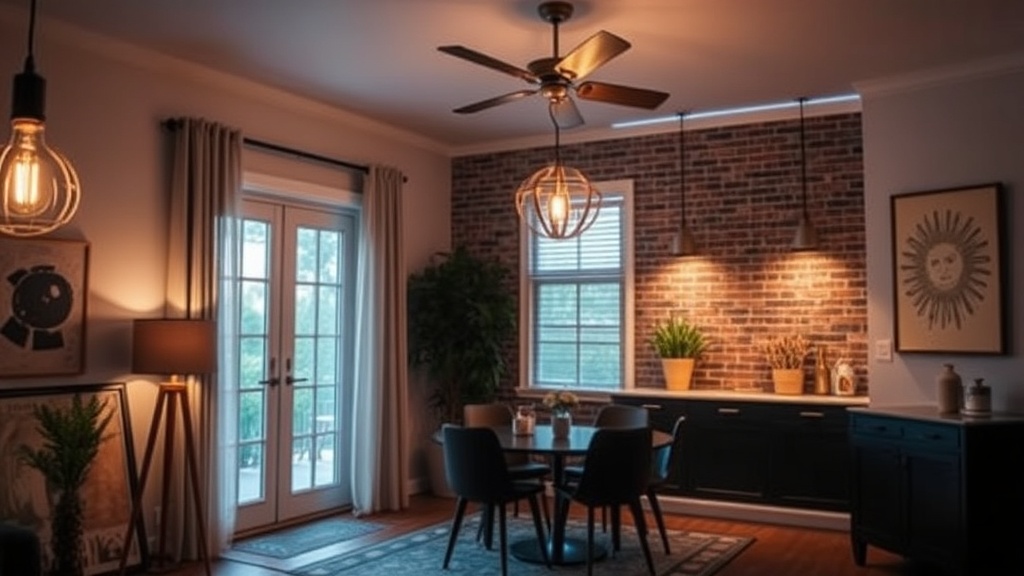
7 Smart Ways to Upgrade Your Lighting Without Rewiring

Swap to Smart Bulbs
Use Plug-in Wall Sconces
Add Battery-Operated Picture Lights
Layer with LED Light Strips
Utilize Cordless Table Lamps
Try Dimmable Plug-in Pendants
Incorporate Decorative Lanterns
Does your living room feel strangely clinical or uninviting despite having several lamps scattered around? Most people assume that to fix bad lighting, they need to hire an electrician to run new circuits or install recessed cans, but that is a costly misconception. Lighting is the most effective way to manipulate the perceived volume and mood of a room, and you can achieve professional-grade results using only the outlets you already have. This guide breaks down seven tactical ways to layer light, adjust color temperatures, and use existing electrical points to transform your space without a single screwdriver or a trip to the hardware store for wiring supplies.
1. Layer Your Light Sources
The biggest mistake in residential design is relying on a single, high-output overhead light. This creates "flat" lighting that casts harsh shadows and makes a room feel two-dimensional. To create depth, you must implement three distinct layers: ambient, task, and accent lighting. Ambient lighting is your base layer, while task lighting is functional, and accent lighting is purely for drama or highlighting specific objects.
Instead of turning on the ceiling light, use a combination of floor lamps for ambient light, a desk lamp for task-oriented work, and perhaps a small battery-operated spotlight to highlight a piece of art. By distributing light at different heights—the floor, the tabletop, and the eye level—you create a sense of three-dimensional space. If you are working in a compact area, look into ways to make a small kitchen feel much larger through strategic lighting, such as placing small cordless lamps on countertops to draw the eye upward and outward.
2. Prioritize Color Temperature (Kelvin)
If your home feels like a hospital waiting room, the culprit is likely your Kelvin rating. Light color is measured in Kelvin (K). A low Kelvin number (2700K to 3000K) produces a warm, yellowish glow, while a high Kelvin number (5000K and above) produces a blue, daylight-mimicking light. Most people buy whatever is cheapest at the big-box store, often ending up with "Cool White" bulbs that feel sterile and aggressive.
For living areas and bedrooms, stick to "Warm White" (2700K). For kitchens or workspaces where precision is required, you can move up to "Neutral White" (3500K-4000K), but avoid anything labeled "Daylight" in a residential setting unless you are in a garage or a laundry room. When shopping, look at the fine print on the box for the specific Kelvin number rather than just the wattage. Consistency is key; if you have three different lamps in one room, ensure they are all within 200K of each other to avoid a jarring visual clash.
3. Use Cordless LED Technology for "Floating" Light
The lack of an outlet is often the only thing standing between you and a perfectly lit corner. Modern LED technology has solved this with high-quality, rechargeable battery-operated lamps. These are not just small "fairy lights"; you can now purchase high-end, heavy-base cordless table lamps that look identical to corded versions. These are ideal for placing in the middle of a dining table, on a bookshelf, or on a window sill where a cord would look messy and interrupt the lines of the room.
When selecting these, look for models with adjustable brightness (dimmable) and USB-C charging capabilities. A cordless lamp placed on a bookshelf provides "accent lighting" that can make a standard library or media center look much more expensive. It eliminates the "cord clutter" that often ruins the clean aesthetic of a well-designed room.
4. Master the Art of the Plug-In Sconce
Wall sconces are a staple of high-end interior design, but they usually require a junction box and professional installation. A plug-in sconce offers the exact same aesthetic benefit without the structural modification. By using a decorative cord—perhaps a braided fabric cord in a contrasting color—you can turn a blank wall into a focal point.
Position these strategically to frame a piece of art or to flank a bed. In a bedroom, a pair of plug-in sconces on either side of the headboard provides excellent task lighting for reading and frees up space on your nightstands. This is a much cleaner solution than bulky table lamps, especially in smaller rooms where surface area is at a premium. If you want to create a cozy bedroom retreat, the soft, directional light from a sconce is far more effective than an overhead light or a bright bedside lamp.
5. Utilize Light-Reflecting Surfaces
You can effectively "double" your light output without adding a single new fixture by utilizing the physics of reflection. Mirrors are the most efficient tool for this. A mirror placed directly opposite a window will catch the natural light and bounce it deeper into the room, brightening the entire space during the day. At night, a mirror placed opposite a lamp will amplify the light's reach.
To make this look intentional rather than accidental, use large-scale mirrors. A tall, leaning floor mirror can act as a secondary light source by reflecting the glow of a nearby floor lamp. For a more subtle effect, consider metallic accents. Brass, polished chrome, or even high-gloss paint on a single wall can act as a soft reflector, diffusing light and preventing the "dark corner" syndrome common in rooms with high ceilings.
6. Control the Light with Dimmers and Smart Plugs
The ability to control the intensity of light is what separates a "lit" room from a "moody" room. If you cannot install a traditional dimmer switch into your wall, use smart plugs or plug-in dimmers. A smart plug allows you to control any lamp via a smartphone or voice command, but more importantly, it allows you to set schedules and, in many cases, adjust the brightness levels.
This is particularly useful for creating "scenes." You can program your lamps to slowly brighten in the morning to mimic a sunrise, or dim to a low, warm level at 8:00 PM to signal to your brain that it is time to wind down. This level of control allows you to transition a single room from a bright, productive office during the day to a soft, relaxing lounge in the evening without moving a single piece of furniture.
7. Hide the Hardware: Cord Management
The biggest deterrent to using more lamps is the "spiderweb" of cords trailing across the floor. If you are adding multiple light sources to upgrade a room, you must treat the cords as part of the design. A visible, messy black cord stretching from a lamp to a baseboard immediately cheapens the look of a room.
Use several different tactics to hide these:
- Cord Covers: Use paintable cord raceways that can be adhered to the baseboard or wall to create a seamless line.
- Decorative Cord Covers: Instead of hiding them, make them a feature. Use braided fabric cords in colors that complement your wall paint.
- Furniture Placement: Position your furniture (like a sofa or an armchair) to naturally mask the path of the cord.
- Rug Placement: A well-placed area rug can easily hide a cord running from a lamp to a distant outlet, ensuring the visual path remains clean.
Upgrading your lighting is about understanding how light interacts with your specific architecture and furniture. By focusing on Kelvin temperatures, layering different heights of light, and utilizing smart technology, you can achieve a sophisticated, high-end look on a standard household budget.