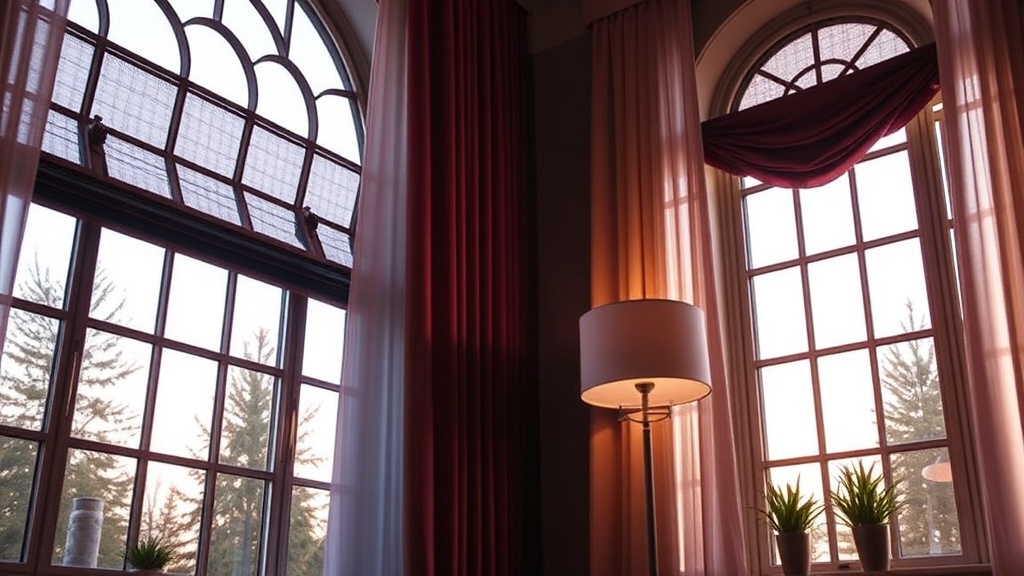
Creating a High-Impact Window Treatment Strategy

A client once sat in a sun-drenched living room that looked like a high-end catalog, yet she felt completely unsettled. The furniture was expensive, the rug was hand-knotted, and the art was original—but the windows were bare, stripped of everything except a single, thin Venetian blind. The room felt unfinished, like a person wearing a tuxedo without a shirt underneath. This post breaks down how to treat your windows as structural elements rather than afterthoughts, focusing on scale, light control, and the physics of drapery.
What is the best way to hang curtains for a high-end look?
To achieve a high-end look, you should hang your curtain rods high above the window frame and wide beyond the casing. Most people make the mistake of hanging the rod right on the window trim—this is a mistake that makes your ceilings look lower than they actually are. Instead, aim to place the rod about 6 to 10 inches above the window frame, or even closer to the ceiling if you want to draw the eye upward.
Think of the window as a frame for a painting. If you crowd the frame, the "art" looks small. If you extend the rod width-wise, you create a sense of architectural volume. This trick isn't just about aesthetics; it's about the way light hits the fabric. A wider rod allows the fabric to rest against the wall rather than blocking the glass, which lets in more natural light during the day.
Here is a quick checklist for placement:
- Width: Extend the rod 8–12 inches past the window edges on each side.
- Height: Aim for 4–10 inches above the top of the casing.
- Depth: Ensure the rod sits far enough away from the wall so the fabric doesn't bunch against the glass.
If you're working with a small room, don't be afraid of the height. Even in a modest apartment, a high rod creates the illusion of volume. It’s one of the top interior design upgrades that provides an instant sense of scale.
How much fabric do I need for curtains?
You need enough fabric to create full, lush folds even when the curtains are closed, which typically means ordering 2 to 2.5 times the width of the window.
If you buy a panel that is exactly the width of your window, the moment you pull it shut, it will look like a flat, cheap sheet. Designers call this "skimpy" drapery. To get that heavy, expensive weight, you want "fullness." If your window is 40 inches wide, you shouldn't just buy 40 inches of fabric. You want the total width of your panels to be roughly 80 to 100 inches. This ensures that when the curtains are closed, they still have those beautiful, undulating curves.
The weight of the fabric matters just as much as the width. A heavy linen or a velvet will hang with much more authority than a thin polyester. If you're using a lightweight sheer, you'll need even more width to prevent it from looking limp. It's a matter of physics: gravity does the heavy lifting if the material has enough mass.
Consider these three common fabric behaviors:
| Fabric Type | Visual Effect | Best Use Case |
|---|---|---|
| Linen | Organic, relaxed, textured | Casual living rooms or breakfast nooks |
| Velvet | Heavy, luxurious, light-blocking | Formal dining rooms or bedrooms |
| Sheer (Cotton/Voile) | Airy, soft, diffused light |
When selecting your hardware, don't forget the bracket strength. A heavy velvet curtain on a thin, flimsy rod is a recipe for a midnight collapse. Check the technical specifications for your hardware to ensure it can support the weight of your chosen textile.
Should I use blinds, shades, or drapery?
The most successful interior designs use a combination of window treatments—specifically, a "layered" approach involving both a functional shade and a decorative drapery.
The truth is, one single treatment rarely does it all. A blind is great for light control and privacy, but it's a purely functional tool. It lacks the warmth and softness of fabric. On the other hand, drapery provides the "soul" of the room, but it doesn't always offer the precision needed for light-sensitive tasks like watching a movie or sleeping.
I suggest a two-tier system. Use a functional element—like a Roman shade or a roller shade—for the utility of light control, and then layer drapery over it for the aesthetic. This is how you build a room with depth. It’s the difference between a room that feels "decorated" and a room that feels "designed."
Think about your room's primary function before you buy. If it's a bedroom, your priority is light-blocking (blackout). If it's a sunroom, your priority is UV protection and glare reduction. You might look at products like the Lutron automated shades for high-tech light control, or perhaps a simple linen panel from West Elm for a more relaxed vibe.
When you layer, you're also adding texture. Texture is a fundamental part of how we experience a space. If you've already mastered layering textures in a reading nook, you'll find that window treatments are just another opportunity to play with that concept. A heavy velvet curtain against a bare wall feels cold; a velvet curtain against a soft, textured wallpaper feels intentional and cozy.
One thing to watch out for: don't let the layers get too busy. If you have a patterned wallpaper, keep your window treatments solid. If your room is a sea of neutral colors, a subtle pattern in your drapery can provide the much-needed visual interest. It's a balancing act, not a competition.
The hardware is the skeleton of your window treatment. Without a strong foundation, even the most beautiful silk will look subpar. Make sure your finials—the end pieces of the rod—match the vibe of the room. A sleek, black metal rod feels modern and architectural, while a brass or wooden rod feels more traditional and warm.
Don't forget the floor. The "length" of your curtain is a major design decision. You have three main options: the "kiss" (where the fabric just barely touches the floor), the "puddle" (where the fabric bunches slightly on the floor), and the "float" (where it hangs about half an inch above). For a modern, clean look, go with the "kiss." For a romantic, old-world feel, a small puddle of 1–2 inches is perfect. Avoid the "float" that's too high off the ground—it looks like you outgrew your curtains. It's a small detail, but it's the difference between a room that looks curated and one that looks temporary.
Steps
- 1
Measure Twice for Height and Width
- 2
Select Your Hardware and Rod Style
- 3
Choose Fabric Weight and Opacity
- 4
Determine the Perfect Hang Height