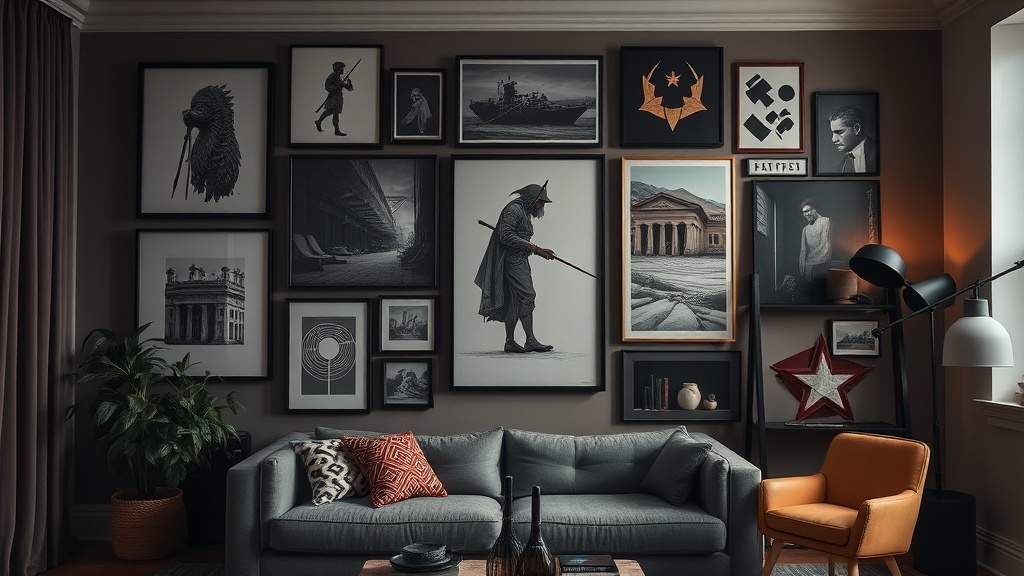
How to Create a Moody Maximalist Gallery Wall

For years, the design world has treated "maximalism" like a dirty word. To the minimalist purist, maximalism is often dismissed as "clutter" or a lack of restraint. But as an architect, I look at space through the lens of composition, tension, and weight. A truly great maximalist space isn't just a pile of stuff; it is a highly curated, intentional orchestration of texture, color, and history. When you add a "moody" element to the mix—think deep charcoals, forest greens, and midnight blues—you aren't just decorating; you are creating an atmosphere.
A moody maximalist gallery wall serves as the soulful anchor of a room. It tells a story that is both personal and visually sophisticated. However, without a structural framework, a gallery wall can quickly devolve into visual noise. To avoid the "cluttered look" and achieve the "curated look," you need to apply a bit of architectural discipline to your creativity. Here is how to build a gallery wall that feels intentional, expensive, and deeply evocative.
Step 1: Establish Your Color Architecture
In a moody maximalist scheme, the background is just as important as the art itself. Most people make the mistake of trying to hang dark art on a white wall. This creates a jarring "floating" effect that lacks cohesion. To achieve that seamless, high-end look, you want the wall to act as a velvet stage for your pieces.
Consider painting the wall in a saturated, matte finish. Deep tones like navy, burgundy, or even a soft black provide a receding background that makes the textures of your frames and the colors of your art pop. This creates a sense of depth, making the room feel larger and more mysterious rather than smaller and cramped. If you aren't ready for a permanent paint job, you can achieve a similar effect with dark, textured wallpaper. This approach is one of my favorite high-low design hacks on a budget, allowing you to introduce complex patterns without the long-term commitment of heavy renovations.
Pro Tip: When selecting your palette, look for "analogous" colors—shades that sit next to each other on the color wheel. A wall of deep teal paired with art featuring emerald and forest green creates a sophisticated, low-contrast harmony that feels incredibly lush.
Step 2: Curate with Intentionality (The "Rule of Three" Elements)
The secret to a gallery wall that looks like it belongs in a museum rather than a thrift store is variety within a theme. To prevent the wall from looking one-dimensional, I recommend a mix of three specific categories of objects:
- The Two-Dimensional: This includes traditional framed paintings, sketches, photography, or even vintage botanical prints.
- The Three-Dimensional: This is where the "maximalism" truly lives. Incorporate small sculptural elements, such as a brass wall sconce, a carved wooden mask, or a small ceramic relief. These pieces break the flat plane of the wall and add actual shadows.
- The Textural: Think of items that introduce a tactile quality. A small woven tapestry, a piece of framed textile, or even an antique mirror can add a layer of "weight" to the composition.
When selecting your pieces, don't just look for "pretty" things. Look for pieces with a sense of history. An aged, slightly tarnished brass frame or a weathered oil painting adds a sense of "lived-in" luxury that brand-new decor simply cannot replicate. If you are looking for inspiration on how to blend different aesthetics, check out my guide on 5 timeless decor styles to see how maximalism can coexist with more traditional frameworks.
Step 3: Designing the Compositional Grid
This is where the architect in me takes over. There are two primary ways to lay out your gallery wall: the Structured Grid and the Organic Cloud. For a moody, maximalist look, I often recommend a hybrid approach.
The Structured Grid
A structured grid uses consistent spacing and uniform frame sizes. This is excellent if you want the wall to feel formal and orderly. If you are using a dark, moody color palette, a structured grid prevents the room from feeling chaotic. It provides a "spine" for the eye to follow.
The Organic Cloud
The organic cloud approach is more free-form. You start with a large "anchor" piece in the center (or slightly off-center) and build outward. This is the quintessential maximalist method. To keep this from looking messy, you must maintain a consistent "visual weight." If you place a heavy, dark-framed oil painting on the left, you must balance it with something of similar visual mass on the right—perhaps a 3D object or a larger piece of art.
The Layout Process:
- Lay it out on the floor first: Never start by hammering nails. Lay your pieces out on the floor in front of the wall. This allows you to move pieces around without the frustration of holes in the drywall.
- Mind the "Gaps": In a maximalist wall, the spacing between frames (the "negative space") is just as important as the art. Aim for a consistent gap of 2 to 3 inches between pieces to create a sense of cohesion.
- Check the Sightlines: Stand back and look at the arrangement from different angles. Is one side feeling "heavier" than the other? Adjust accordingly.
Step 4: The Role of Lighting (The Final Layer)
You can have the most stunning collection of art in the world, but if your lighting is a single, harsh overhead bulb, your gallery wall will look flat and lifeless. In a moody maximalist space, light is your most powerful tool for creating drama. You want to use light to highlight the textures and create depth through shadows.
I highly recommend incorporating layered lighting. Instead of relying on the "big light," use a combination of:
- Picture Lights: Small, battery-operated or hardwired lights that sit directly above a piece of art. These create a focused glow and a sense of prestige.
- Sconces: As mentioned in the composition step, adding a sculptural wall sconce provides both a 3D element and a source of warm, ambient light.
- Accent Lighting: A small floor lamp or a directed spotlight can cast soft shadows that make your 3D objects feel more dramatic.
Common Mistakes to Avoid
Even with the best intentions, it is easy to fall into a few common traps. Here is what to watch out for:
1. The "Thrift Store Overload": While vintage finds are the soul of maximalism, avoid buying things just because they are cheap. If a piece doesn't speak to your color palette or your personal story, leave it. A collection of "random stuff" is clutter; a collection of "meaningful objects" is a gallery.
Final Thoughts
Creating a moody maximalist gallery wall is an exercise in balance. It requires the bravery to embrace color and texture, but also the discipline to organize those elements into a coherent composition. Think of your wall as a canvas where you are layering history, light, and shadow. When you get it right, it won't just be a wall in your house—it will be a destination within your home.
Go forth and curate. Your walls deserve a story.
Steps
- 1
Collect a Diverse Collection
- 2
Lay Out Your Composition
- 3
Test with Paper Templates
- 4
Hang and Adjust for Balance