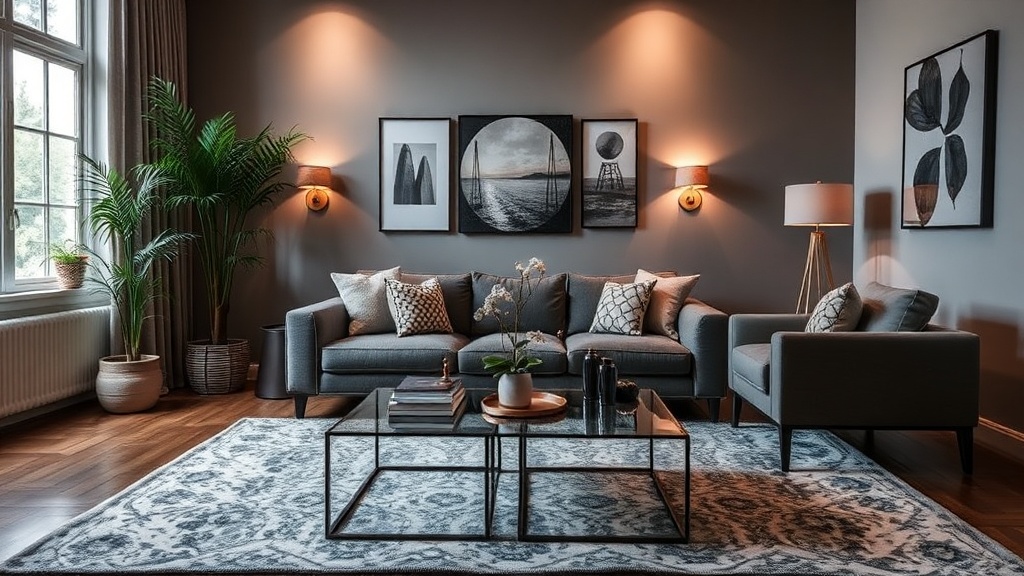
Why Your Coffee Table Is Crowding Your Living Room

The Geometry of the Living Room: Why Your Coffee Table Is Crowding Your Space
You walk into your living room, sit on the sofa, and realize you have to physically lift your knees to avoid striking your shins on the heavy wooden block in the center of the room. This isn't just an annoyance; it is a failure of spatial planning. A coffee table that is too large, too heavy, or incorrectly positioned disrupts the circulation of a room, making even a spacious living area feel cramped and dysfunctional. This post breaks down the mathematical and aesthetic reasons your coffee table might be sabotaging your layout and how to select a piece that serves the room rather than dominating it.
In architectural design, we look at "circulation paths"—the invisible lanes people use to move through a room. When a coffee table encroaches on these paths, the room stops being a place of relaxation and becomes an obstacle course. To fix this, you need to look beyond the style of the table and start looking at its footprint, its visual weight, and its relationship to the surrounding furniture.
The Golden Ratio of Coffee Table Dimensions
Most people shop for a coffee table based on how much surface area they want for books or drinks, but they neglect the relationship between the table and the sofa. If the table is too large, it swallows the seating area; if it is too small, it looks like an afterthought. To find the "Goldilocks" zone, follow these three structural rules:
- The Two-Thirds Rule: A coffee table should be approximately two-thirds to three-quarters of the length of your sofa. If you have a standard 84-inch three-seater sofa, your table should ideally be between 56 and 63 inches long. A table that is nearly as long as the sofa looks cumbersome and creates awkward gaps at the ends.
- The Height Equilibrium: The height of your coffee table should be within 1 to 2 inches of your sofa's seat cushions. If the table is significantly higher, it creates a visual barrier that prevents eye contact and makes the room feel "blocked." If it is too low, it becomes a tripping hazard and looks disproportionate.
- The Clearance Constant: This is where most DIY designers fail. You must maintain 14 to 18 inches of space between the edge of the sofa and the edge of the table. This provides enough room to stretch your legs while still being able to reach a drink. If you have less than 12 inches, the room will feel claustrophobic.
Understanding Visual Weight and Materiality
In design, "visual weight" refers to how much an object's appearance draws the eye. A solid, dark walnut block has high visual weight. A glass-topped table with thin brass legs has low visual weight. Even if two tables occupy the exact same square footage, they will affect the room's perceived size differently.
If you are working in a smaller apartment or a room with low ceilings, a heavy, opaque coffee table acts like an anchor, pulling the eye downward and making the floor space feel "used up." To combat this, look for pieces that utilize transparency or "leggy" silhouettes. A glass or acrylic table (often called a "ghost" table) allows the eye to see right through the object to the rug and floor beneath it, creating the illusion of uninterrupted space. This is a common trick used in maximizing small spaces because it reduces visual clutter.
Conversely, if you have a very large, airy room with high ceilings, a tiny, spindly metal table might look lost. In that scenario, you need a piece with more "heft"—perhaps a stone or thick timber surface—to ground the seating arrangement. The goal is balance, not just "small is better."
The Problem with "The Big Box" Aesthetic
The most common mistake I see is the "Big Box" coffee table: a massive, rectangular, solid-wood piece that sits directly on the floor with no visible legs. While these are popular in many modern furniture catalogs, they are the enemies of small-to-medium living rooms. Because they sit flush with the floor, they create a solid block of color and texture that interrupts the floor plane.
To make a room feel more expansive, opt for furniture that shows the floor underneath it. When you can see the rug or the hardwood continuing under the legs of the coffee table, the brain perceives the room as having more continuous surface area. This is why a mid-century modern style table with tapered legs or a tripod base is often a better choice for a standard living room than a heavy, pedestal-style table.
Solving the Shape Dilemma
The shape of your coffee table dictates how people move around it and how the room feels. Each shape serves a specific architectural purpose:
- Rectangular: Best for long sofas and traditional layouts. They provide the most surface area but can feel rigid and "sharp" in a room with many curves.
- Round: Ideal for small spaces and conversation circles. Because they lack corners, they improve circulation and prevent bruised shins. They also soften the hard lines of a rectangular sofa.
- Oval: A hybrid approach. An oval table offers the length of a rectangle (good for long sofas) with the softness and safety of a round table.
- Square: Best for large, U-shaped or L-shaped sectionals. A square table acts as a central hub for a large seating group, but it can feel very heavy if it isn't elevated on legs.
The Layering Technique: Using Nested Tables
If you find that a single large coffee table is either too small for your needs or too big for your space, stop trying to force a single piece to do all the work. Instead, use the "nesting" technique. A set of nesting tables—one larger primary table and one or two smaller, mobile side tables—allows you to customize the footprint of your furniture based on the activity.
For example, during a movie night, you might pull the smaller tables out to provide extra surface area for snacks. When you want the room to feel open and clear for guests, you can tuck them away. This modularity is a hallmark of smart design; it acknowledges that a room's function changes throughout the day.
Check Your Rug First
Often, a coffee table looks "wrong" not because of the table itself, but because the rug beneath it is poorly scaled. If your coffee table is sitting on a rug that is too small, the table will appear to be "floating" in the middle of the room, disconnected from the seating. This makes the entire arrangement look disjointed and cramped.
A coffee table should ideally sit entirely on the rug, or at the very least, the front legs of your sofa should be anchored by the rug. If your rug is a small accent piece rather than a foundation, the coffee table will feel like an intruder rather than a centerpiece. Before buying a new table, ensure you fix your rug placement mistakes to create a proper stage for your furniture.
Summary Checklist for Your Next Purchase
Before you click "buy" on that next piece of furniture, run it through this architectural audit:
- Length: Is it roughly 2/3 the length of my sofa?
- Height: Is it within 2 inches of my seat cushions?
- Clearance: Will I have at least 14 inches of space to walk around it?
- Visual Weight: Does the material (glass, wood, metal) match the "heaviness" of my sofa?
- Legs: Can I see the floor underneath it to maintain a sense of openness?
Design is not about buying the most expensive item in the showroom; it is about understanding how objects interact with the volume of a room. A coffee table should be a functional tool that facilitates conversation and comfort, not a roadblock that dictates how you move through your own home.