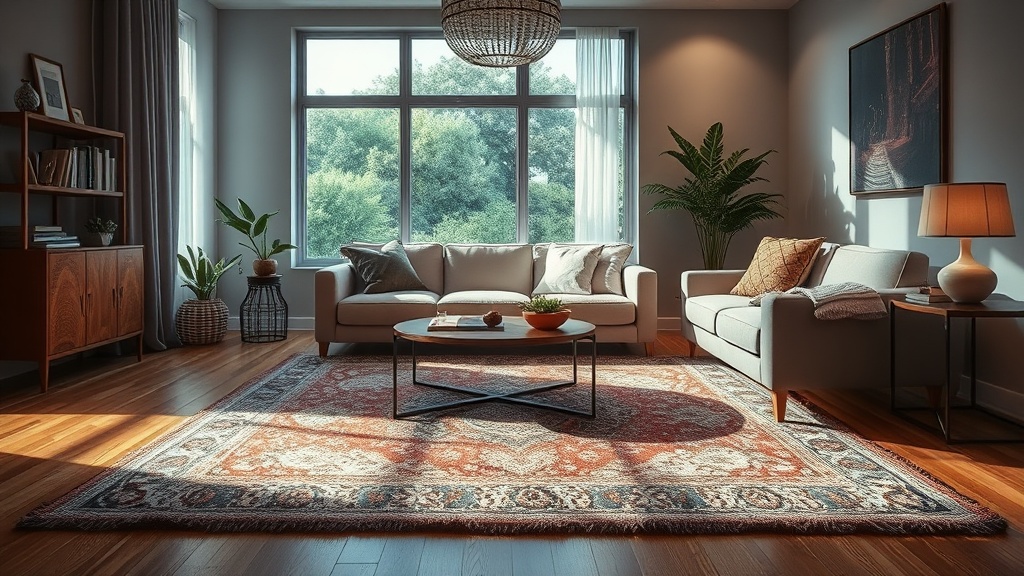
Why Your Rug Is Making Your Room Look Small

A client walks into a living room that features a high ceiling, a large window, and a substantial velvet sofa. The room is objectively spacious, yet the moment they step onto the floor, the space feels cramped, disjointed, and strangely stunted. The culprit isn't the furniture or the paint color; it is a 5x7 area rug sitting in the center of the room like a postage stamp. This common mistake—underestimating the scale of floor coverings—is the primary reason many rooms feel smaller than they actually are. This post explains the architectural logic behind rug sizing and how to select a piece that expands your visual boundaries rather than shrinking them.
The Visual Anchor Principle
In architecture, we look at how a room is "grounded." A rug serves as the foundation for your furniture grouping. When a rug is too small, it fails to act as an anchor. Instead, it creates a visual "island" that makes the furniture look like it is floating aimlessly in a sea of bare floor. This fragmentation breaks the eye's path, making the room feel cluttered and unfinished.
Think of a rug as the stage for your furniture. If the stage is only half the size of the actors, the performance feels awkward. To create a sense of cohesion, the rug must provide enough surface area to unify the various elements of a seating or dining arrangement. When the rug is large enough to support the weight of the room's visual components, the eye perceives the entire area as one singular, expansive zone.
The "Floating Furniture" Trap
The most frequent error is the "floating furniture" look, where only the front legs of the sofa and chairs touch the rug, or worse, no furniture touches the rug at all. This creates a sense of tension. The gaps between the rug and the walls become "dead zones" that highlight the lack of scale. If you have a standard 10x12 living room, a small rug will make the perimeter of the room feel like an empty void, drawing attention to the fact that the rug doesn't belong there.
If you find yourself in this position, you are likely experiencing why your living room feels unfinished. The lack of a cohesive base prevents the room from reaching its full potential. To fix this, you must move away from the "centerpiece" mindset and move toward the "foundation" mindset.
Calculating the Correct Scale for Every Room
Size selection is not a guessing game; it is a matter of mathematical proportion. To avoid the shrinking effect, use these specific guidelines for the most common room types.
The Living Room: The Rule of Legs
In a living room, you have three primary options for how the rug interacts with your seating. Each choice changes the perceived scale of the room:
- The All-In Approach: All furniture legs—including the back legs of the sofa and the side chairs—sit entirely on the rug. This is the gold standard for large, open-concept spaces. It creates a massive, unified zone that makes the room feel grand and intentional.
- The Front-Leg Approach: The front two legs of all seating pieces rest on the rug, while the back legs sit on the bare floor. This is the most popular method because it provides a sense of connection without requiring a massive, expensive rug. It bridges the gap between the seating and the floor effectively.
- The Perimeter Approach: Only the coffee table sits on the rug. Avoid this. This is the "postage stamp" effect that makes a room feel smaller and more disjointed.
For a standard medium-sized living room, aim for at least an 8x10 or a 9x12. If you are using a low-profile sofa like a West Elm modular piece, a larger rug is essential to balance the low center of gravity.
The Dining Room: The Clearance Rule
The dining room is where small rugs cause the most functional and visual frustration. A rug that is too small will look like a decorative mat rather than a functional floor covering. The rule here is simple: the rug must accommodate the movement of the chairs.
When a person pulls a chair out to sit down, the back legs of that chair will inevitably slide off the rug. If the rug is too small, the chair legs will hit the edge of the rug and the bare floor mid-motion, creating a visual "stutter." To prevent this, ensure the rug extends at least 24 to 30 inches beyond the edge of the table on all sides. If you have a 60-inch round table, a 9-foot or 10-foot round rug is the minimum requirement to keep the scale feeling proportional and luxurious.
The Bedroom: The Layering Logic
In a bedroom, the rug serves to soften the transition from the bed to the rest of the room. A common mistake is placing a small runner or a small rectangular rug at the foot of the bed. This cuts the room in half visually. Instead, place a large area rug horizontally under the bottom two-thirds of the bed. The rug should extend out from the sides of the bed by at least 18 to 24 inches to provide a soft landing for your feet when you step out of bed. This creates a sense of breadth and makes the sleeping area feel like a dedicated, expansive sanctuary.
Texture, Pattern, and Visual Weight
Once you have the size correct, you must consider the "weight" of the rug. A rug isn't just a color; it is a texture. A heavy, high-pile shag rug has more visual weight than a flat-weave jute rug. If you have a room with many heavy, dark furniture pieces, a thin, light-colored rug might look "weak" and fail to ground the space.
Conversely, if you are working with a very small room, a high-contrast pattern can actually make the floor feel more "busy" and cramped. If you want to make a space feel larger, look for rugs with low-contrast patterns or solid textures. Using a rug with a subtle, organic texture—such as a high-quality wool or a subtle silk blend—can add depth without creating the visual noise that shrinks a room.
The Impact of Color and Border
The color of your rug can manipulate the perceived boundaries of your walls. A rug that is close in tone to your flooring (e.g., a light beige rug on a light oak floor) will blend in, making the floor appear continuous and expansive. A rug with a high-contrast border (e.g., a dark navy rug on a white floor) creates a hard stop for the eye, effectively "boxing in" the center of the room and making it feel smaller.
If your goal is to make a small room feel more expansive, avoid rugs with heavy, dark borders. Instead, opt for rugs with a "bleeding" edge or a more organic, non-linear pattern that allows the eye to move more freely across the surface.
Practical Checklist for Your Next Purchase
Before you hit "checkout" on that new rug, run through this architectural checklist to ensure you aren't making the same mistakes:
- Measure the Furniture: Don't just measure the floor; measure the footprint of your sofa, chairs, and coffee table.
- Tape It Out: Use painter's tape to outline the dimensions of the rug on your actual floor. Leave the tape there for 24 hours. Walk around the "rug" to see how it interacts with your movement and your furniture.
- Check the Clearance: For dining rooms, pull your chairs out to their furthest position and ensure the rug is still underneath them.
- Consider the Material: Will a high-pile rug make the room feel too "heavy"? Will a flat-weave rug look too "thin" against your large sectional?
- Account for the Perimeter: Ensure there is at least 12 to 18 inches of bare floor visible between the rug and the walls to prevent the room from looking "wall-to-wall" carpeted, which can also feel claustrophobic.
By treating the rug as a foundational architectural element rather than a decorative afterthought, you can transform a cramped, disjointed room into a cohesive, expansive space. Size matters—not just for the budget, but for the very perception of your home's volume.