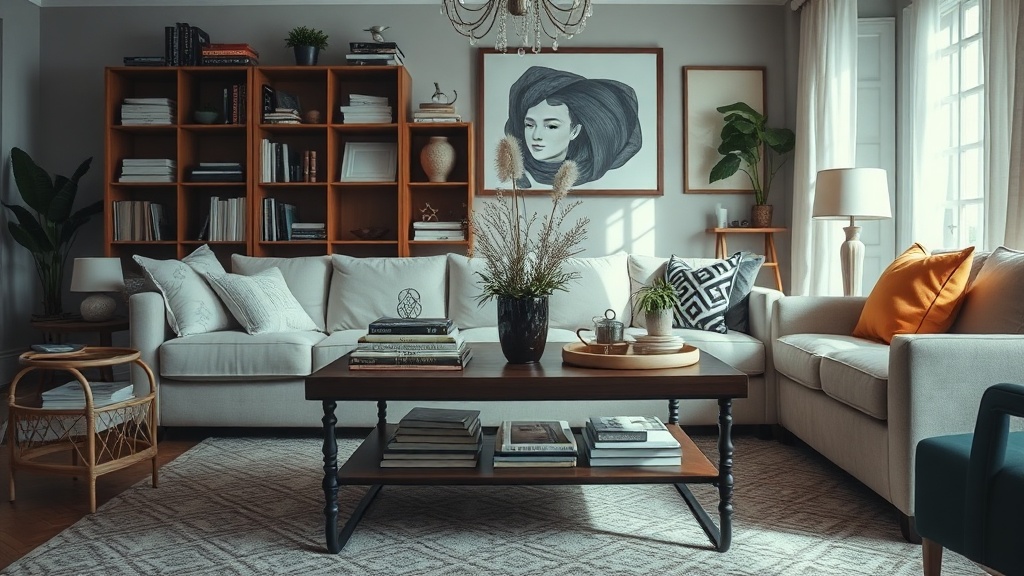
Why Your Coffee Table Looks Cluttered and Boring

A stack of mismatched coasters, a half-empty candle, a remote control, and a single, lonely ceramic bowl. This is the common anatomy of a coffee table that has lost its way. Most people treat the coffee table as a landing strip for daily debris rather than a focal point of the living room. When a surface is covered in small, unrelated objects, the eye has nowhere to rest, creating a sense of visual noise that makes even a well-designed room feel disorganized. This guide breaks down the structural principles of tabletop styling to help you move from accidental clutter to intentional design.
The Problem of Scale and Proportion
The most frequent mistake in coffee table styling is a lack of scale. If you place three small tea lights and a tiny succulent on a large, reclaimed oak table, the objects will look like debris rather than a curated vignette. In architecture, we look at the relationship between a structure and its components; in interior design, we look at the relationship between the surface area and the objects resting upon it. If your table is large, your "anchor" objects must be substantial enough to command the space.
To avoid the "tiny object" trap, you need an anchor. An anchor is a large-scale item that establishes a visual base. This could be a heavy marble tray, a large-format linen-bound book, or a substantial sculptural bowl. Without an anchor, your smaller items—like a candle or a brass trinket—will appear scattered and accidental. If you find yourself working with a smaller, circular glass table, avoid heavy wooden trays. Instead, use a single, oversized sculptural piece to prevent the table from looking heavy and unbalanced.
When selecting these pieces, consider the height-to-width ratio. A tall, thin vase might look elegant, but if it is paired with a flat, wide tray, the lack of verticality can make the table feel "bottom-heavy." Aim for a variety of heights to create a sense of rhythm. If you are struggling with the dimensions of your furniture, ensure you haven't bought furniture that is too big for your space, as an oversized table leaves very little room for error in styling.
The Three-Layer Method for Depth
A flat coffee table is a boring coffee table. To create a professional look, you must build in layers. This adds depth and prevents the surface from looking like a single, uninteresting plane. I recommend a three-layer approach: the Foundation, the Vertical, and the Accent.
1. The Foundation (The Base)
The foundation is the object that groups everything else together. This is usually a tray or a stack of books. A tray is particularly effective because it creates a "contained" zone, which signals to the brain that the items inside are intentional and not just clutter. A rectangular brass tray works well on a rectangular table, while a circular wooden dough bowl provides a softer, more organic feel for a round table. This layer provides the boundaries for your design.
2. The Vertical (The Height)
Once your foundation is set, you need to add height. This breaks the horizontal line of the table and draws the eye upward. A single branch in a ceramic vase, a tall taper candle in a heavy holder, or even a sculptural piece of driftwood provides this necessary verticality. The key is to ensure this piece is not so tall that it obstructs the view of people sitting across from you. You want to create interest, not a visual wall.
3. The Accent (The Detail)
The accent is the small, textured item that adds a final touch of personality. This could be a small brass object, a single piece of sea glass, or a small bowl for matches. These items should be used sparingly. If you add too many accents, you revert to clutter. The goal is to have one or two items that catch the light or offer a different texture, like the matte finish of a stone coaster against a polished metal tray.
For more help with grouping objects effectively, read our guide on The Rule of Three: A Decorator's Secret Weapon for Perfect Styling.
Texture and Material Contrast
A coffee table that is all one material looks sterile and uninspired. If you have a glass coffee table, adding only glass or acrylic decor will make the piece disappear. If you have a heavy wooden table, adding only dark wood objects will make the space feel monochromatic and heavy. To create a professional-grade vignette, you must introduce contrasting textures.
- Hard vs. Soft: Pair a hard marble tray with a textured linen-bound book or a small ceramic vessel.
- Shiny vs. Matte: Place a polished brass candle snuffer next to a matte, unglazed terracotta pot.
- Organic vs. Geometric: If your table has sharp, modern lines, introduce an organic element like a piece of coral, a wooden bowl, or a leafy green plant to soften the edges.
Texture is the "secret ingredient" that makes a room feel lived-in rather than staged. A stack of books provides a rhythmic, geometric texture, while a bowl of moss or a piece of driftwood provides a natural, irregular texture. This tension between the man-made and the natural is what creates visual interest.
Managing Functionality and the "Clutter Creep"
The biggest challenge with a coffee table is that it is a functional object. It is where you set your coffee, your laptop, or your remote. In a design-led home, we treat these functional items as part of the decor or we hide them entirely. The moment a remote control or a stack of mail becomes a permanent fixture on your coffee table, the design integrity is lost.
To maintain a clean look while keeping the table functional, implement these three strategies:
- The "One-In, One-Out" Rule: If you bring a new decorative object to the table, an old one must be removed. This prevents the gradual accumulation of "stuff."
- Use Hidden Storage: If you have a coffee table with a lower shelf or a drawer, use it. This is the designated home for remotes, coasters, and charging cables. The surface should remain a stage for design, while the shelf remains a tool for utility.
- The Tray Method for Daily Use: If you must have items on the table (like a candle or a small dish), keep them within the confines of your decorative tray. This keeps the "mess" contained to a specific area, making it much easier to clear away at the end of the day.
If your living room feels cluttered because the furniture itself is overwhelming the room, you might need to re-evaluate your layout. A coffee table that is too large can make the entire seating area feel cramped and disorganized. If you suspect your furniture is the culprit, check out our post on why your rug is making your room look small, as the scale of your rug and coffee table work together to define the space.
Common Mistakes to Avoid
Even with the best intentions, it is easy to fall into certain stylistic traps. Watch out for these common errors:
Symmetry Overload: While symmetry is a classic architectural principle, a coffee table that is perfectly symmetrical can often feel stiff and "museum-like." A little asymmetry—placing a tall vase on one side and a shorter stack of books on the other—creates a more dynamic and inviting energy.
The "Too Much" Syndrome: Many people believe that more is better. They fill every square inch of the table with objects. A well-styled table needs "negative space"—the empty areas that allow the eye to breathe. If your items are touching each other constantly, you have too much. Give your objects room to exist individually.
Ignoring the View: Always consider how the table looks from a seated position. If you are sitting on the sofa, you are looking at the table from a low angle. A tall vase might block the view of the person sitting across from you, or a very bright, reflective object might create a distracting glare. Design for the person using the room, not just the person walking through it.
By treating your coffee table as a curated composition rather than a storage surface, you elevate the entire room. Focus on scale, build in layers of height and texture, and always prioritize the relationship between your objects and the empty space around them. A successful coffee table isn't about what you put on it, but how those pieces interact with the surface and the room at large.